
Edited by: Dhruv Reddy | Graphic by: Khoi Estefano Chu
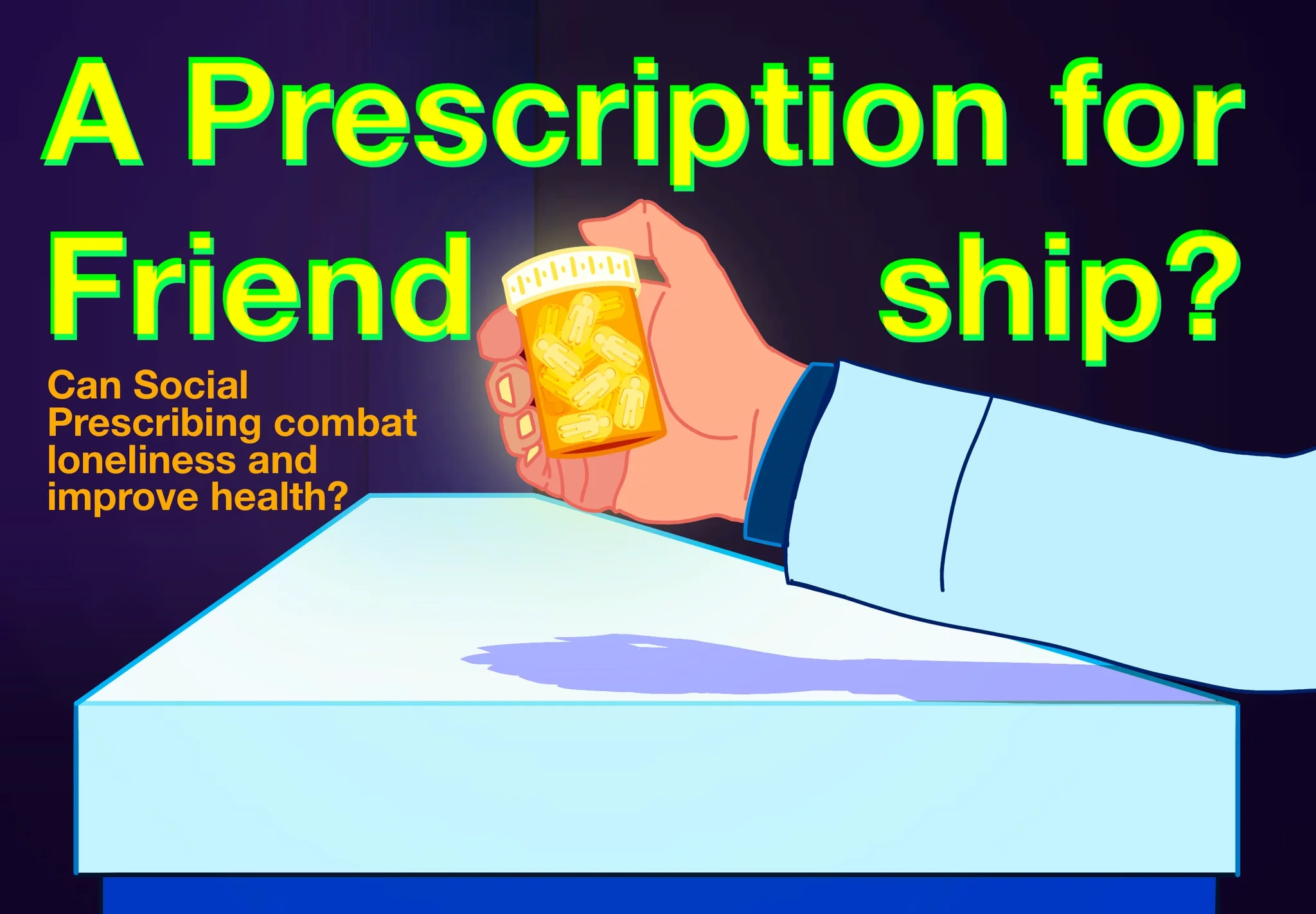
Can Social Prescribing combat loneliness and improve health?
Every day, it feels like we are constantly surrounded by people: our classmates, roommates, coworkers, strangers we see on our commute, the barista who knows your name at your local Starbucks. Yet, today's society can feel desperately isolating. The number of people around us does not equate to real social connectedness.
This problem is nothing new, of course, but have you ever thought that the solution may lie in primary healthcare? Well, England did. The NHS implemented social prescribing as a key component of its Universal Personalized Care. It connects people with community activities, groups, and services tailored to their social, practical, and emotional needs to improve their health and wellbeing. In practice, healthcare providers can refer patients to a link worker, who helps them find community groups and services that meet their social and practical needs: a link worker might connect someone experiencing loneliness with a local walking group, giving them an opportunity to meet others while staying active (NHS England).
Could a stronger sense of community be the prescription for better health? That is the promise of social prescribing, and it's easy to see why it’s appealing. But turning a referral into real relief takes more than pointing someone toward a local activity. People need to be able to attend and have a reason to keep coming back. The referral opens the door; what happens next determines whether it helps.
A 2024 study offers an encouraging, yet cautious, result. Researchers followed 114 adults experiencing loneliness in Queensland, Australia, comparing usual care with usual care plus social prescribing. After eight weeks, the social prescribing group showed greater improvement in one measure of loneliness and in social trust. They also reported better well-being, less psychological distress, and less social anxiety, but improvements in these areas were not significantly greater than those in the usual-care group. That distinction is crucial: feeling better after a program is not necessarily the same as feeling better because of it.
There are other reasons to temper our enthusiasm. Participants were not randomly assigned, so differences between the groups could partly explain the findings. And eight weeks offers only a snapshot: would those connections, and their benefits, still be present a year later? The study gives us reason to consider social prescribing as a legitimate treatment for loneliness. Whether it can deliver lasting improvements across chronic physical and mental health conditions is yet to be concluded.
Social prescribing offers a promising way for healthcare to address loneliness. England’s NHS shows how community support can become part of routine care. As other health systems explore this approach, they must consider what makes participation possible: accessible activities, support for community organizations, and follow-up beyond the initial referral. A prescription may open the door to a friendship, but the necessity of this program is ensuring people maintain those connections.