Edited by: Elle Scord | Graphic by: Nalani Woonton
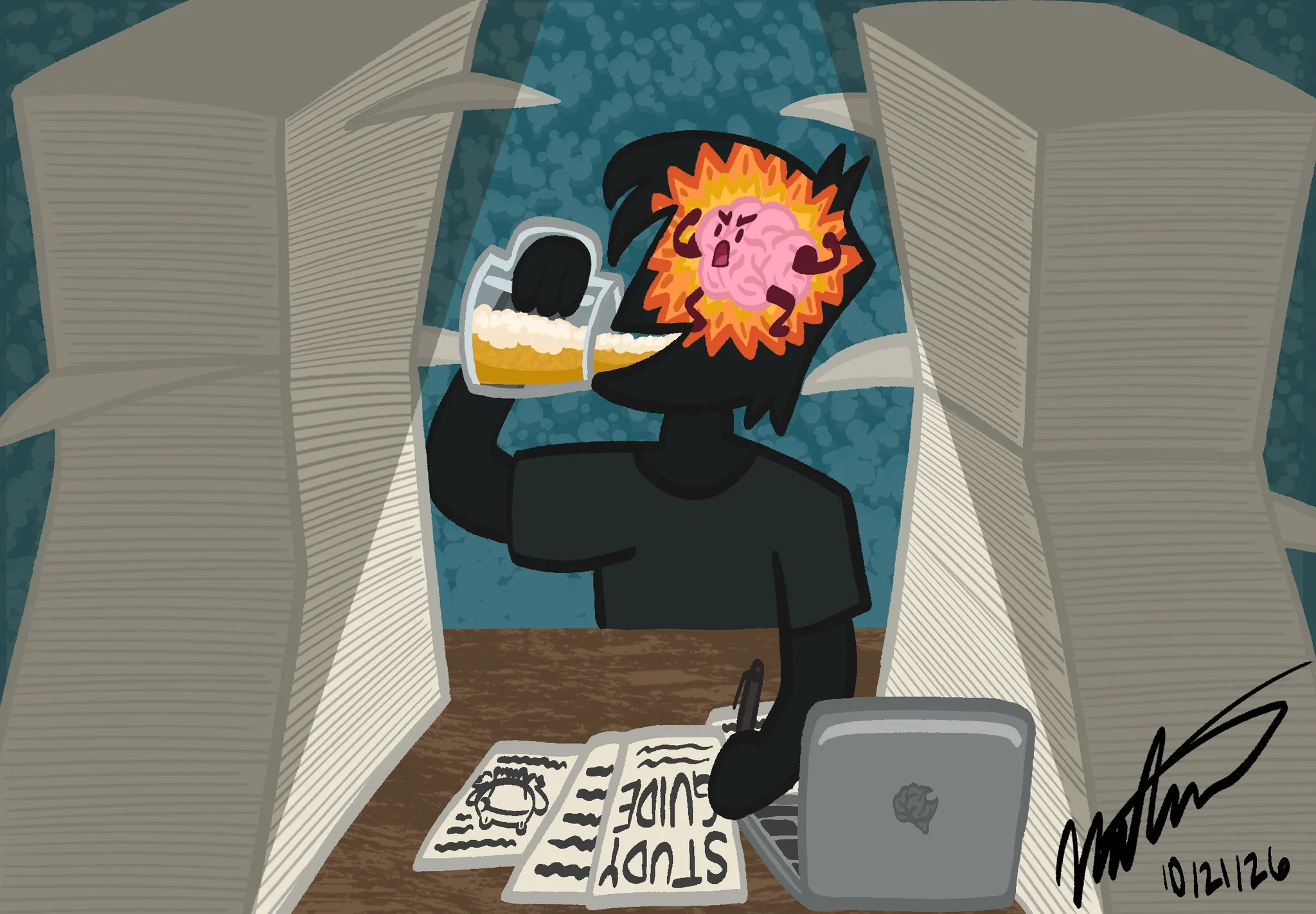
As academic pressure increases by the minute, several students are resorting to drinking a “study beer” before a revision session. But what effects does this actually have on the brain?
Recently, a friend of mine drank a couple of beers before a three-hour study session. This left me rather befuddled: was he truly learning, or did he want an excuse to chug a few Bud Lights? That’s when he introduced me to the concept of a “study beer.” This is based on the assumption that a little alcohol can relax you, and potentially cause you to work more efficiently. So, is this college fad a trick to help you relax and focus? Or, does it pose as a facade to actual learning?
First, we must understand that alcohol functions as a depressant. It increases the effects of GABA, a chemical messenger in the brain that reduces neural activity, while reducing signaling at NMDA glutamate receptors, which play roles in communication, learning, and memory. This impairs activity in our brain systems that support attention and executive function: the skills used to plan and focus. While one drink does not magically erase everything you know, it can affect the machinery the brain needs to process and retain information.
That machinery includes working memory: the mental workspace that allows us to do mental math, follow a recipe, remember and type in a phone number, or form connections between ideas while reading. A meta-analysis involving 1,629 healthy adults found that alcohol caused a small-to-medium decline in working memory. The greatest impairments appeared when people had to manipulate information rather than simply pay attention to it. Higher blood alcohol concentrations were also linked to steeper declines in memory-related processes. When we study, our brains continuously manipulate information by comprehending complex processes & ideas.
Another variable we must investigate is alcohol dosage. In a one trial, 30 adults completed the same set of cognitive tests after consuming either a placebo, a low alcohol dose, or a moderate alcohol dose. In the low dose group, participants’ average peak blood alcohol concentration was 0.04%. Participants from this group reported feeling slightly more intoxicated and sedated, but the study did not detect significant cognitive impairment. However, in the high dose group, the average peak BAC was 0.07% and spatial working memory, attention span, and even motor functions were significantly more impaired. However, these values do not translate into a universal number of beers, as factors like food, body weight, sleep, medications, alcohol tolerance, and drinking speed can change a person’s response to alcohol.
But even if my friend could follow his notes while drinking, would he still remember them after the buzz wore off? Some research by Manoj Doss helps us understand what alcohol can make tougher during a study session. In their research study, participants were told to learn and remember labels, some of which were paired with pictures, after receiving either alcohol or a placebo. Two days later, those who had consumed alcohol before learning had more trouble recalling specific details, particularly for emotionally salient material. In my friend’s case, he may have felt as though he understood the material that night, but it might’ve been tougher to actually remember it during the exam. Alcohol before studying, then, does not just make learning feel slower. It can interfere with forming the memories revision is supposed to strengthen.
On the contrary, the study-beer myth does have one interesting piece of evidence. In a small experiment involving 40 male social drinkers, intoxicated participants performed better on a word-association puzzle that asked them to identify connections between seemingly unrelated phrases. This does not mean alcohol makes people “better thinkers”. A word-association puzzle rewards unusual connections; studying requires a different set of abilities - holding and organizing information in the moment, then retaining it well enough to retrieve later. Alcohol may occasionally help the first type of loose association, but it’s far less helpful when the goal is to accurately remember that information.
But, if it has so many negative impacts on attention and memory, why does alcohol make us feel like we’re studying better? Why do we feel like we’re studying more?
Part of that answer may be that it helps reduce anxiety. In an experiment by Hefner and Curtin, participants were given electric shocks: some were given the shocks randomly, while others were told the shock was coming. The researchers measured their blinking - a defensive startle response that happens more often when we perceive a threat. Turns out, alcohol did not reduce this response when a shock was certain. However, its calming effect became stronger as the shock became less predictable. A deadline is obviously different than a laboratory shock, but the finding helps explain the appeal of a study beer: uncertain outcomes are stressful, and alcohol can temporarily subdue that feeling.
So, the answer to my friend’s study session is slightly more clear than “it depends.” Alcohol’s effects do vary with dose, timing, task, and the individual. But, drinking before revising material does nudge our brains to function inefficiently in that moment, impacting attention, working memory, and the formation of new memories. While a “study beer” may make our work and deadlines feel more manageable, it’s unlikely to make the material easier to learn.