Edited by: Lara Sadi | Graphic by: Mellanie Mack
With sports-betting apps and celebrity-driven campaigns bringing the casino to our phones, the psychology of gambling has never been more personal, or more profitable.
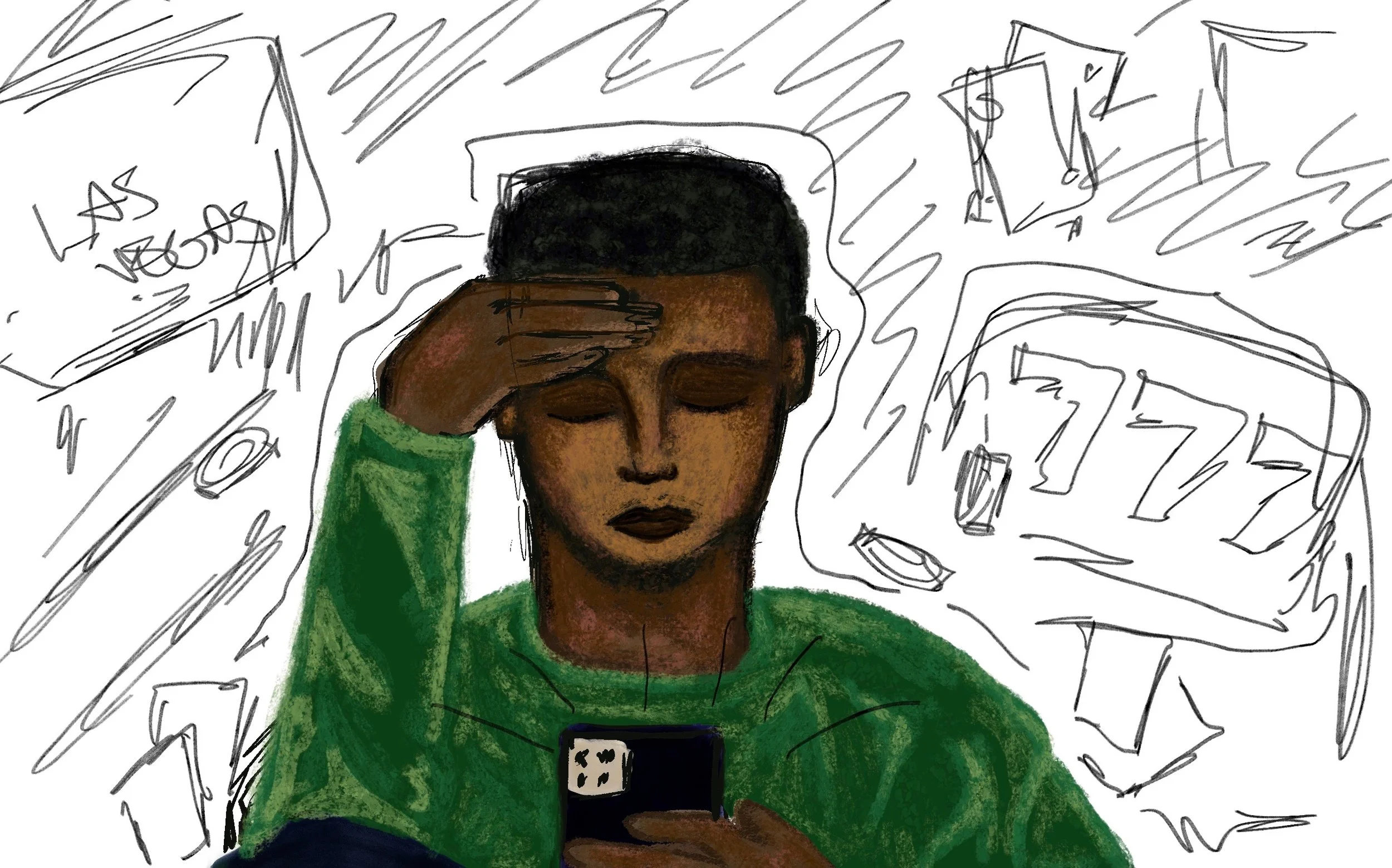
It’s 2 a.m. on the Las Vegas Strip, and it’s business as usual. Neon lights illuminate the sky, slot machines ring out through open casino doors, and a loud cheer erupts from inside as someone hits the jackpot. You had planned to leave an hour ago. But you’re still here, telling yourself it’s just one more spin. This mentality is what built Sin City. And now, with the same allure fitting in your pocket, neuroscience helps us understand why it’s so difficult to resist.
Psychologists discovered decades ago that the habits that stick do not necessarily come from receiving a reward every time. Instead, unpredictable rewards can make a behavior especially difficult to stop. This pattern is called a variable reward schedule. Slot machines use this exact system: because any pull of the lever could win, players are encouraged to keep trying.
Dopamine is the brain chemical most linked to this pull, a messenger neurons use to signal reward. It’s often called the “pleasure chemical,” but it’s really about anticipation. Researchers recorded dopamine neurons in monkeys in a 2003 Science study; these monkeys had learned which visual cues meant a likely reward and which didn’t. As the animals waited, activity in these neurons increased, peaking when the odds were 50-50. The authors suggested this signal may play a role in risk-taking behavior.
Losing can activate the same circuit. In a 2009 study published in Neuron, volunteers played a simplified slot machine while inside a functional magnetic resonance imaging scanner, which tracks brain activity by monitoring blood flow changes. The researchers examined near misses, where the reel stops one position away from a jackpot. Players reported near misses as less pleasant than ordinary losses, but they were more likely to keep playing after near misses, especially when they chose the gamble themselves. Near misses trigger the same brain regions, such as the striatum and insula, that are activated by actual wins. Although financially a near miss is equivalent to a loss, the brain processes it more like a win.
A slot machine stays in the casino. But a betting app is different; it goes wherever its user does and speeds up the cycle. A friend of mine recently won $700 on Robinhood, an app better known for stock trading, by betting on the USC-Washington football game. A payout like that makes the next bet feel worthwhile. In-play betting, for instance, lets users bet on individual moments in a game, and instant cash-out settles a bet before the game ends. This cuts the time between a bet and its outcome, so users get more rounds of anticipation per hour. Researchers found that people at higher risk of gambling harm use in-play betting and instant cash-out more often, according to a 2026 study in the Journal of Behavioral Addictions. Near misses are also common with parlays, which pay only if all outcomes are correct, and a single loss can create one.
The newest entrants do not call themselves sportsbooks at all. Novig is a sports prediction market where users trade on game outcomes. The experience is similar to traditional sportsbooks, as the reward system still responds to the uncertainty of the result. Novig launched its “Just Sports” campaign nationwide in September 2026, featuring actress Sydney Sweeney, who is also a strategic partner and has an equity stake in the company. According to CNBC, the provocative advertisements drew backlash from some female athletes, and Novig's co-founder said first-time depositors rose by more than 218% when comparing the 20 days before and after the launch. A 2025 systematic review in the journal Addiction suggests why that matters: across many types of media, exposure to sports-related gambling advertising was associated with more gambling behavior.
A celebrity campaign can drive app downloads. People stay due to features like fast bets, near misses, and uncertain payouts. Not everyone who places a bet will develop a problem, but the urge to try again isn't based on a real chance of winning. Near misses are still losses, and what's being sold is the suspense, not a likely win.
If you or someone you know is struggling with gambling, you can reach the National Problem Gambling Helpline by calling or texting 1-800-MY-RESET (1-800-697-3738), or by chatting online, for 24/7, free, and confidential support.
