
Edited by: Jeslyn Chen | Graphic by: Emily Chavez
Picture the tallest, strongest person imaginable. Now add four feet, triple the muscle mass, and cover the whole person in fur. Congratulations, that’s basically Chewbacca, and he doesn’t abide by the laws of nature. He’s a Wookiee: an eight foot tall, roughly 250 pound, and fully-furred biped who is supposedly super strong. By every scientific understanding, he’s a walking contradiction who’s existed for nearly five decades without anyone stopping to ask the question that actually matters. How is he alive? Evolution has spent hundreds of millions of years making sure this specific combination never happens. Not even Vader managed to take Chewie apart, but science might. Starting with his skeleton, the thing quite literally holding him up.
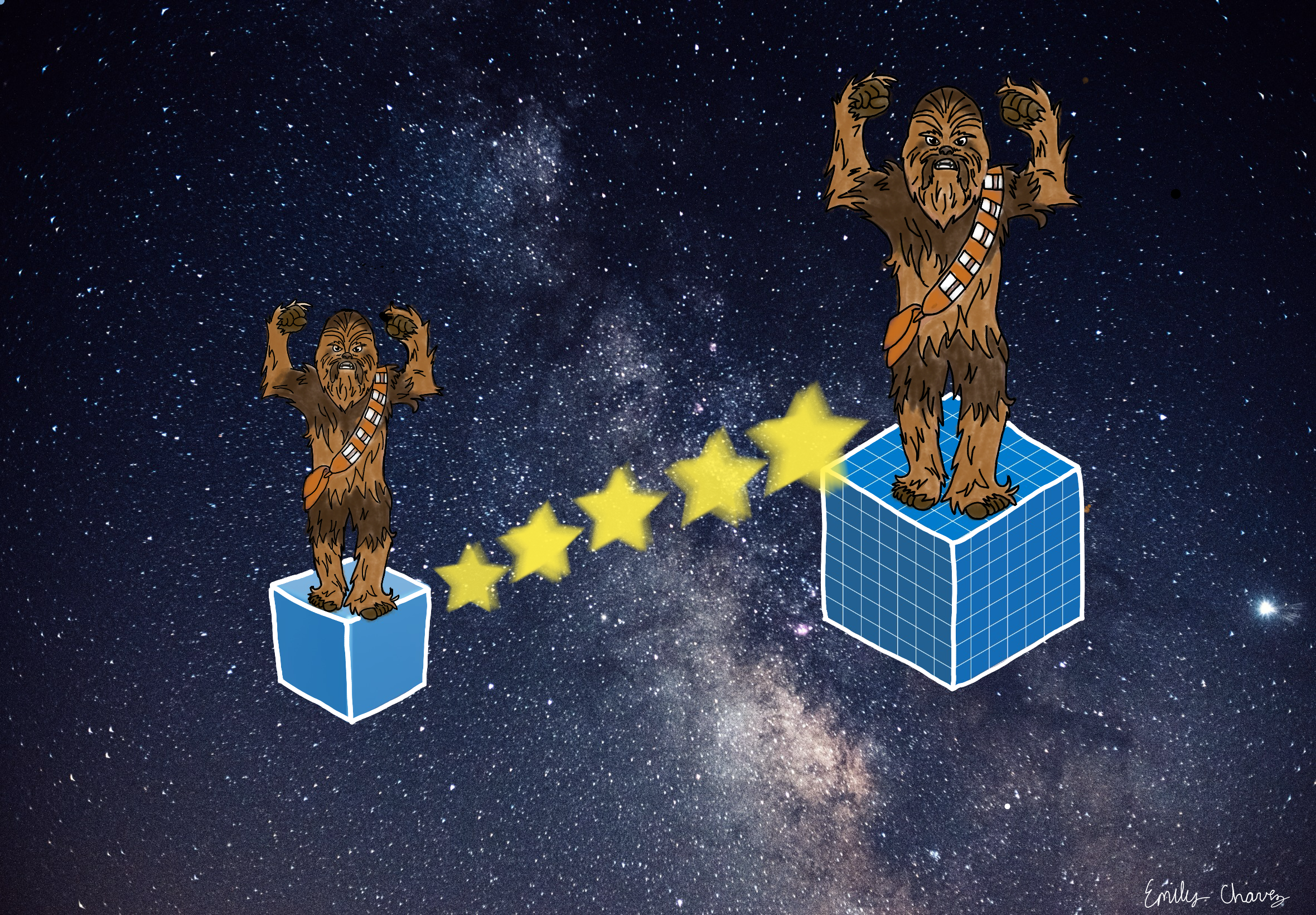
The central flaw with the concept of the Wookiee is the square cube law. As the height of an object increases linearly, its volume and mass increase with the cube of that scale factor; however, the strength of its supporting structures only increase with the square. Thus, the strength of a bone or muscle is determined by its cross sectional area, not how much total material it has. Now if one was to go and double someone’s height they would roughly quadruple the cross sectional area of their bones, then they would go on to multiply their mass by eight. The bigger the scale, the worse the gap gets. J.B.S Haldane, one of the 20th century’s most influential biologists, discussed this phenomenon in his 1926 essay “On Being the Right Size.” He explains how giant human-like creatures cannot physically exist, at least not in the way that the media portrays them. For example, if a person was scaled up to 60 feet tall, they would weigh a thousand times more while their bones would only be able to support about a hundred times more of a load. Chewbacca is (thankfully) not 60 feet tall. But standing at roughly eight feet tall with 250+ pounds of dense muscle, he would also face similar issues if created with human anatomy. For Chewbacca’s skeleton to not fold like a battle droid hit by a stiff breeze, he would need to have disproportionately thicker limb bones, a wider stance, and likely a shorter torso relative to his leg mass. Basically, he’d need gorilla proportions, not human ones scaled up.
His fur is also actively working against him. Bigger bodies have a harder time shedding heat because surface area, where heat escapes, increases slower than volume, where heat is generated. Large land mammals tend to have thin hair because more hair would only trap heat against skin that is already struggling to cool down. For example, elephants evolved to have huge, thin ears that act as an extra radiator surface rather than something to aid their hearing. Chewbacca has a large frame and a full-body pelt while inhabiting Kashyyyk, a forest-like biome. Humid climates such as forests do not suit thick fur due to the heat. For Chewbacca’s furry exterior to be plausible, Kashyyyk needs to be incredibly cold or Wookiee fur needs to have magical properties that no real dense-coated mammal has. Real fur density in mammals traces back to Keratin-associated proteins, which form the hair shaft itself, and to follicle-cycling genes like FGF5, which determine how long a hair’s growth phase lasts before it sheds, longer growth phases mean thicker, denser coats. A sci-fi species with different versions of these genes could hypothetically grow a denser coat than mammals. What biology doesn’t offer, though, is any real-world example of fur evolving specifically to cool a large body down, every actual example ties fur density to insulation, which is the opposite of what Chewbacca would need.
Last but not least, Chewbacca’s muscles would realistically not be able to hold his weight. Muscle force, similar to bone strength, scales with cross sectional area while body mass scales with volume. A proportionally scaled up human would actually be weaker pound for pound since their muscle would gain less strength than their body would gain weight. For example, chimps out lift humans roughly 1.5 times over, while being proportionally smaller due to different muscle fiber type rather than muscle size. Chewbacca’s canon strength would require that same shift toward fast-twitch, high-force muscle fibers. That’s not far fetched: the genes controlling muscle fiber ratios already vary between humans and other apes, so a similar shift in a Wookiee wouldn’t be asking evolution to do anything it hasn’t already done.
So what would a realistic Wookiee actually look like? Take away the prosthetics and Hollywood license, and biology will hand you a shorter, stockier, thin furred, and dense muscle creature more similar to a heavyweight wrestler rather than a basketball player. Still enormous. Still capable of ripping a droid apart. Just not a furry human. Between his skeleton, fur, and muscles, Chewie has three separate biological reckonings coming. May the (square-cube) force be with him, we all know he is going to need it.