Edited by: Anjella Kang Lee | Graphic by: Flora Hu
AI has been in the works for decades, taking much inspiration from biological principles to provide the compute it does today.
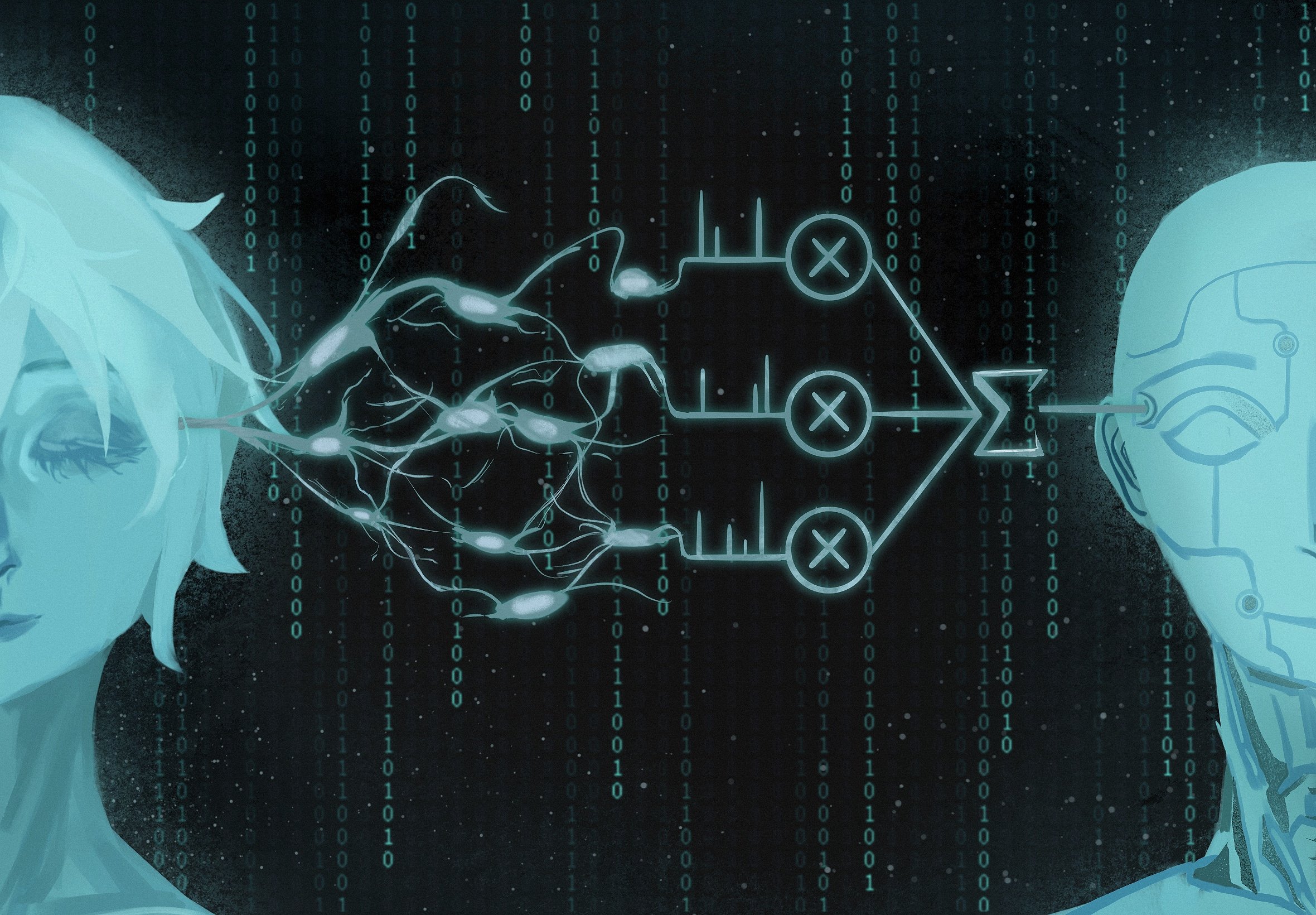
Every time ChatGPT answers a question, when Grammarly finds a spelling mistake, or your phone recognizes your face, there is a distant remnant of the human brain working behind the screen. Today, artificial intelligence has grown beyond the earliest models, but part of its history began with scientists wanting to learn how the brain turns signals into thoughts.
To understand how machines learned to recognize patterns, we first need to meet the biological neuron. The human brain contains roughly 86 billion neurons, which are these minuscule but remarkably intelligent machines in our body. When a neuron receives a stimulus, ions flow across its cell membrane, and if the combined input is strong enough to cross a threshold, the neuron “fires,” sending a signal on to other neurons. While a single cell firing cannot recognize our best friend’s face or what we ate for breakfast, vast networks of neurons indeed allow for this possibility. By combining inputs from thousands of other neurons, these cells can process enormous amounts of information in a fraction of a second, making all of our daily actions like walking and thinking possible. This remarkable ability of neurons to process vast amounts of information was extremely captivating for many scientists, who began to wonder whether the brain’s natural processes could be translated into the language of mathematics and, eventually, built into machines.
Artificial neural networks, computer systems that learn patterns by compiling large amounts of information, emerged in 1943. That year, neurophysiologist Warren McCulloch and mathematician Walter Pitts proposed a simplified artificial neuron. Through mathematical logic and theoretical analysis, they designed a unit that accepted inputs and produced an “on” or “off” output depending on whether those inputs met a threshold, mimicking the action potential of neurons. While real neurons are much more complicated, their model succeeded in showcasing how connected units could carry logical operations. It also offered an answer to a foundational question: could something resembling a nervous system perform a computation?
While McCulloch and Pitts were successful in modeling the inner workings of a neuron, their model had a key limitation: the connections were fixed, so the neuron could not learn from new information. In 1949, psychologist Donald Hebb proposed a fundamental idea in neuroscience: repeated activity between connected neurons could strengthen their connection. Although he never directly worked with artificial neural networks, Hebb’s law laid the groundwork for other AI pioneers, most notably Frank Rosenblatt. In 1958, Rosenblatt introduced the perceptron, an artificial system that adjusted the strength of its connections through a “teacher” whenever it made a mistake. In other words, if you showed the system two categories and told it the correct answer, it would gradually improve at telling them apart by fine-tuning the connections between the artificial neurons.
Still, there was a catch: a single perceptron could learn only very limited patterns and needed a “teacher” to tell it when it was wrong. Researchers wanted to tackle more complex patterns, so they attempted to close that gap by connecting artificial neurons in layers. This meant that each layer could pick up a part of an image, such as recognizing simple edges, and pass what it found to the next layer, which would combine them into shapes and eventually into whole objects. In 1980, researcher Kunihiko Fukushima used this approach in the neocognitron, which was a model inspired by Hubel and Wiesel’s research on the brain’s visual system to recognize patterns, even when they were shifted in position or slightly distorted, such as a handwritten number moved to another corner of the page. The neocognitron also learned without a “teacher.” Instead of being told the correct answer, it was simply shown patterns over and over, and its artificial neurons strengthened their connections to the features they responded to, much closer to Hebb’s original idea that repeated activity strengthens a connection.
However, that alone did not solve the problem of whether AI could correctly label items. Suppose you showed the AI system a picture of an animal—the system can detect the legs, the tail, and the edges of the body and put it into a final prediction of what the animal would be: a cat. But what if the image was actually a dog? It would have to correct its processing of where it went wrong (specifically in how it labeled the different parts of the animals) to differentiate the two animals. In the perceptron, this was simple since the adjustable connections led straight to a final answer. However, in a layered network like the neocognitron, most of the connections get buried in the middle, so it is difficult to ascertain what caused the mistake. Backpropagation, a calculus-based concept popularized in 1986, solved this by sending the error backward through each layer and measuring how much every connection contributed to the mistake, adjusting each one to better identify the object. This idea is much like retracing your steps to find out where you lost your keys or wallet, and in a sense, it combined the best of both earlier models by learning from its errors across various layers.
As ideas like backpropagation became popular, the line between neuroscience and AI grew sharper, especially as mathematics and computing power, rather than biology, began to drive most AI research. Today, calling a neural network an “artificial brain” is almost like calling an airplane an artificial bird: while both can fly, they do so with very different machinery. After all, biological neurons communicate through electrical and chemical signals, change in many ways, and operate within a living organism. Artificial neurons, on the other hand, are mathematical functions that perform calculations and pass the result along. And while their connections can change during training, they do not learn in all the same ways that a brain does.
Yet, just as engineers study birds to design better aircraft, those very differences are still sending some researchers back to biology for fresh inspiration. Spiking neural networks, for example, communicate through brief events that resemble the electrical spikes of neurons. Neuromorphic computer chips are being explored, particularly in fields like robotics and autonomous systems, utilizing spiking neural networks for real-time sensory processing and smart navigation. While these technologies are still developing, they are also continuing the same conversation that began more than 80 years ago: what can studying the brain teach us about building machines? So while AI may not think like a human brain, its history shows us how taking inspiration from nature can lead scientists toward creating something entirely novel and revolutionary.
These articles are not intended to serve as medical advice. If you have specific medical concerns, please reach out to your provider.