
Edited by: Lara Sadi | Graphic by: Fernanda Rodriguez
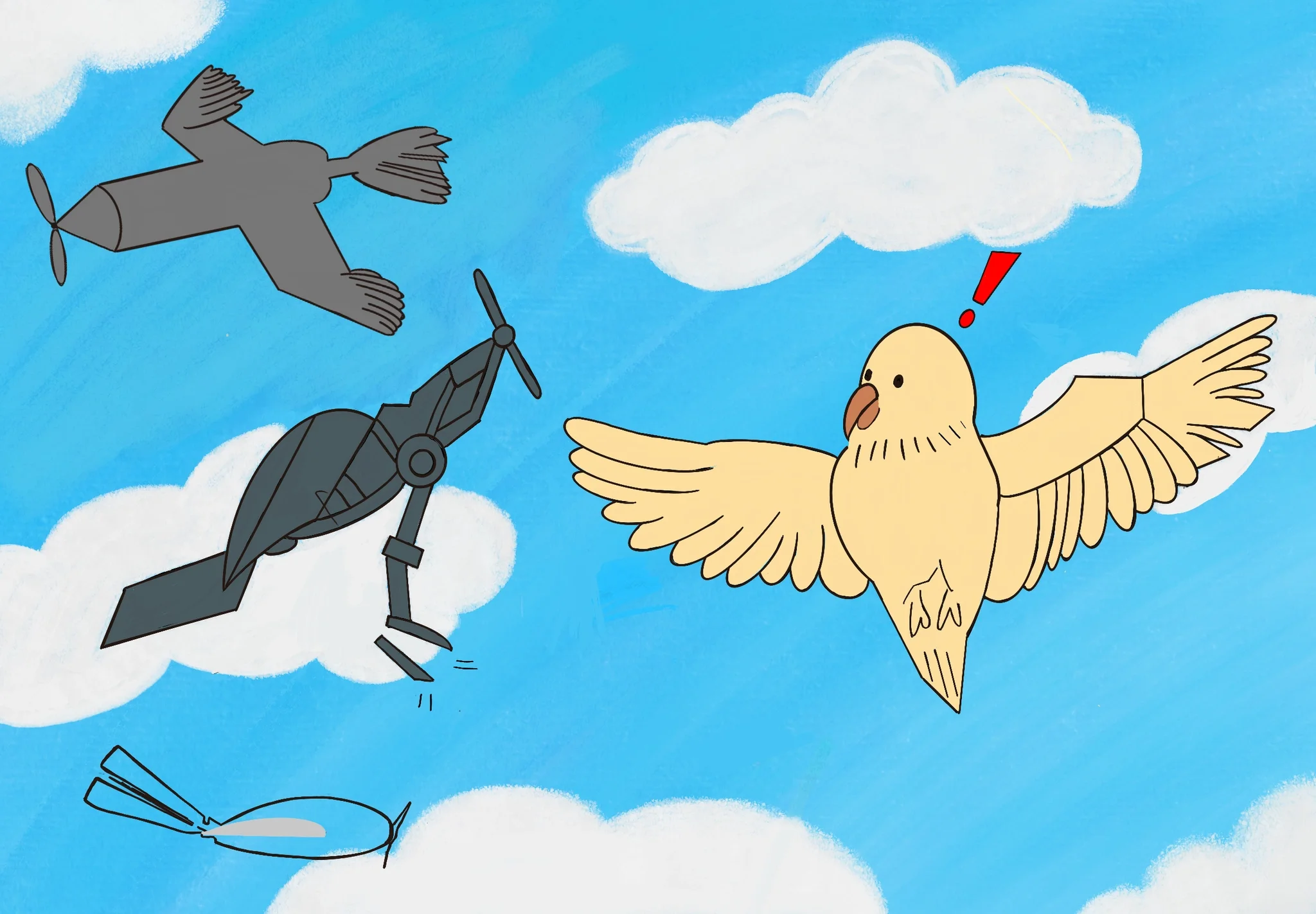
Humans have long wondered how birds fly. Although drone technology has advanced rapidly, it still struggles to match birds’ versatility. Fixed-wing drones are more energy-efficient, while quadcopters can hover and maneuver easily. Birds achieve both without the same trade-off. We all know the basic mechanism of bird flight: flapping. Birds push air downward as their wings thrust in the same direction, causing a reaction force that lifts them. This would be inefficient if the wings followed the same motion back up, since they would push themselves back down. Instead, they fold and morph their wings to interact with the air as little as possible as they flap back up. The wings fold inward to minimize surface area like origami paper and rotate to cut through the air rather than push it.
This movement is a difficult challenge for robots because it requires a system in which a motor alone provides the flapping motion while additional electronics rotate to fold the wing. The team behind RoboFalcon 2.0 achieved this. They used a common mechanical component to convert rotational motion into flapping motion called a Conical Rocker Mechanism (CRM), but added servos and linkages along the wing's edge to fold it properly, plus another set of servos to control the flapping amplitude. They successfully sustained flight despite this complex motion, validating the role of this motion in efficient flapping flight.
Even a bird’s legs factor into its flight patterns. Large birds find walking more energy efficient on the ground because they are so heavy, but smaller birds prefer to hop around since it boosts their speed before taking flight. Robotic birds have proved that developed legs are an efficient takeoff strategy for birds. For example, by mimicking a bird’s jump, RAVEN was able to make takeoff multiple times more energy efficient than taking off from a standstill or falling off an edge. This takeoff method also pairs well with giving drones the ability to walk around land too!
Morphing also lets birds change the shape of their wings and tails by rotating feathers in and out, as well as changing orientations. Think about how a box cutter knife can slide under a sheath. This allows even more complex, agile movement. Current drones rely on ailerons to turn. You have probably seen them flip up when a plane lands. This method, however, is less efficient than birds, which glide and still make sharp turns. That is why the research team behind LisEagle tackled this issue by bending the tail up and down and left and right, as well as bending the wingtips forward and backward. They showed this method could drastically control the turn radius.
The final challenge among all robotic drones is the location of the center of mass, where the drone’s mass is concentrated. To fly, the center of mass must stay relatively centered in 3D space while performing all the motions mentioned earlier in this article. In fact, RAVEN had to use pulley mechanisms to keep the heavy mechanical systems for hopping off the legs, which would have thrown off its center of mass during flight. On top of that, neither RAVEN nor LisEagle had a flapping wing. We are still so far off from flying like a bird… but we still have so much to learn from them!
I want to end this article with a paper on how birds take off and land, offering some heartwarming advice to all those trying to be a bird! I mean – to fly like one. They, after all, are just teasing us at this point. Engineering professors at Stanford took slow-motion videos of birds in flight and observed their flapping to find that their takeoff and landing flaps differ from those in normal flight. They do not need to flap harder. They just flap smarter! And so do we!
These articles are not intended to serve as medical advice. If you have specific medical concerns, please reach out to your provider.