
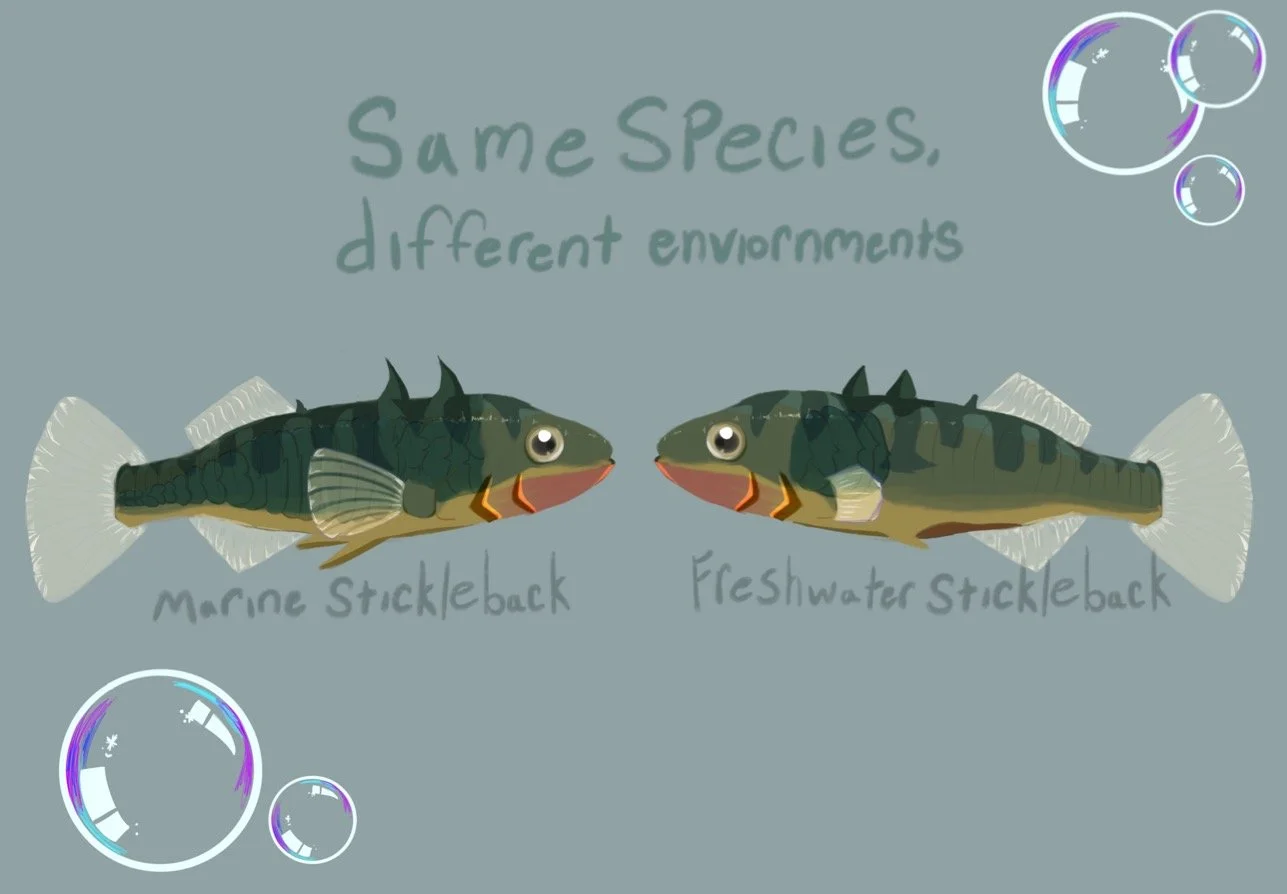
Edited by: Jeslyn Chen | Graphic by: Evangeline Heilman
How do threespine sticklebacks provide evidence for natural selection?
How can a tiny fish help scientists answer some of biology’s biggest questions? At first glance, the threespine stickleback seems like an ordinary pond fish; however, this organism has become one of the most important animals in evolution research. Found in both marine and freshwater environments, sticklebacks have repeatedly colonized new habitats and evolved adaptations to survive in them. This adaptability gives scientists a rare opportunity to watch evolution unfold in real time. Scientists discovered that when populations move into new environments, often because of geographic isolation or environmental change, they frequently develop similar changes in body shape, armor, behavior, and physiology. Comparing these populations has revealed the genetic changes responsible for adaptation; as a result, threespine sticklebacks have transformed our understanding of how evolution works and why species change over time.
Threespine sticklebacks are found in lakes, rivers, streams, and oceans across North America, Europe, and Asia, and these fish face different challenges depending on their habitat. Populations separated by thousands of miles often respond to these challenges in surprisingly similar ways. Research finds that after repeatedly colonizing freshwater habitats, sticklebacks have evolved predictable changes in traits such as body shape, armor, and behavior. Compared with their marine ancestors, freshwater populations often become smaller, differ in body depth and shape, develop changes in feeding structures such as jaw and gill features, have fewer protective lateral plates, and exhibit differences in mating behaviors and coloration.
Threespine sticklebacks are especially valuable for studying evolution because they reproduce quickly and have relatively short generation times. When oceanic sticklebacks colonize freshwater habitats, they often evolve similar adaptations, allowing evolution to be observed across multiple independent populations. Newly established freshwater populations can develop many of the same traits as older populations within only a few decades. This rapid adaptation is possible because sticklebacks carry standing genetic variation, meaning beneficial genetic variants already exist within marine populations and can be quickly selected when environmental conditions change. As a result, genetic and physical changes can be tracked in real time rather than relying solely on fossil evidence.
One of the most exciting discoveries of stickleback research is the identification of genes involved in evolutionary change. By comparing fish populations from around the world, scientists have identified specific regions of DNA that repeatedly differ between marine and freshwater sticklebacks. This includes the EDA gene, which controls armor plate development, as well as regions near WNT7B and SULT4A1, genes associated with developmental signaling, physiology, and adaptation to freshwater environments. Many of these genetic differences do not arise from new mutations each time freshwater populations evolve. Instead, sticklebacks typically reuse older genetic variants that already exist within the species. These include EDA and Kitlg gene variants linked to armor reduction and pigmentation changes that exist at low frequencies within marine populations. This finding changed how scientists think about adaptation by showing that evolution can work with existing genetic tools instead of starting from scratch, helping explain why similar traits repeatedly evolve in separate populations.
Sticklebacks remain one of the best examples of evolution in action. Their ability to adapt repeatedly allows researchers to examine an important question: Is evolution predictable? Repeated genetic changes reveal which traits matter most for survival. Sticklebacks are now helping researchers investigate topics ranging from behavior and genetics to interactions with microbes and parasites. Because stickleback populations respond quickly to environmental shifts, they help researchers understand how species might cope with climate change and ecosystem disruption. Their adaptability allows genetic change to be tracked across generations and tested against evolutionary theory.
The discoveries made through stickleback research extend far beyond evolutionary biology. Many stickleback genes have human counterparts, linking this research to broader questions about genetics, disease, and human development. By revealing how populations respond to new environmental pressures, sticklebacks help researchers better understand the role of genetic diversity in survival. As environmental challenges continue to affect ecosystems worldwide, this small fish continues to provide big insights into adaptation, resilience, and the future of life on Earth.