
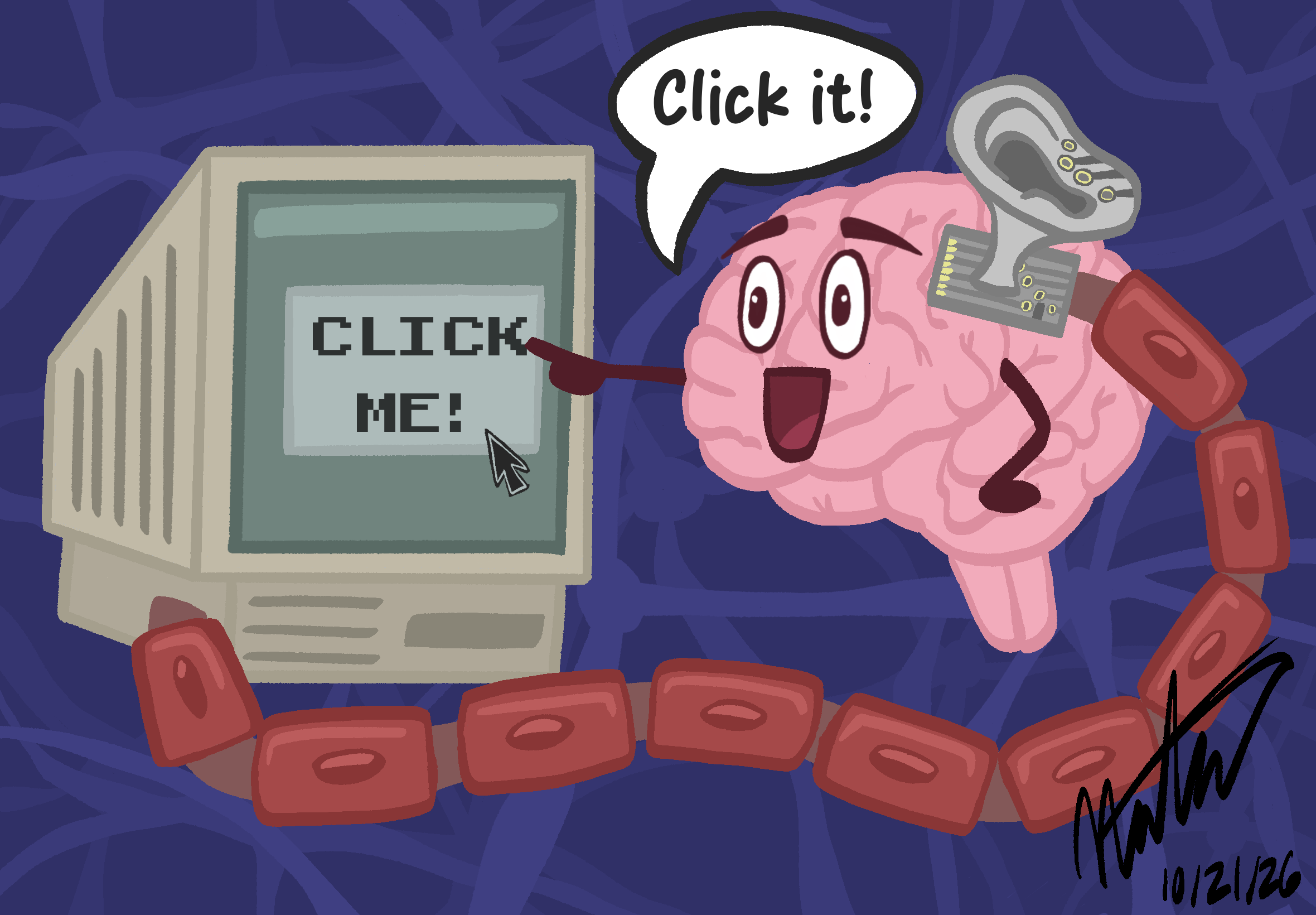
Edited by: Elle Scord | Graphic by: Nalani Wooton
As treatments for neurological diseases continue to advance, we can decode a paralyzed patient's intentions, stimulate neurons to ease tremors, and even combine these functions in a single, flexible device. Now we face a harder question: where does treatment end and interference with one's sense of self begin?
Imagine yourself staring at a computer screen, trying to open a YouTube video—except, your hands don’t move. Instead, you think about where the cursor should go, and it slides over to click on the thumbnail. You haven’t touched anything. That’s exactly what happened to Noland Arbaugh, the first person to receive Neuralink’s brain-computer interface during the company’s clinical trial in 2024. In March, Neuralink, the neurotechnology company founded by Elon Musk, proceeded to release a livestream showing Arbaugh moving the cursor with his mind and playing online chess through this new technology. The implant functions by reading electrical activity in his motor cortex when he thinks about moving the cursor and translating that into action on a screen.
This process illustrates the aim of various brain-computer interfaces (BCIs) that have only continued to evolve after Neuralink’s introduction. They detect the specific pattern of brain activity that manifests when someone intends to move or do something, then use software to turn that pattern into a command a computer can act on—a cursor movement, a typed letter, a clicked button. They essentially let someone who cannot physically move still interact with the world. While Neuralink’s approach of implanting threads directly into the brain tissue is the most invasive yet, there are other groups that aim to take a gentler approach. Synchron is a brain-computer interface company, and its device, the Stentrode, is a small mesh of electrodes that are shaped like a stent. This mesh is fed through a vein in the neck instead of opening the skull, and guided up to a blood vessel right next to the motor cortex (same route doctors already use to treat strokes). Once there, the Stentrode reads nearby neural activity through the vessel wall. Both devices have been shown to effectively “read” the neural activity of the subject and “translate” it into something a computer can carry out, without the need for the patient to physically move.
Other implants, meanwhile, aim to not just read brain activity like BCIs do, but actively change it. Deep brain stimulation (DBS) technology sends an electrical signal in particular brain regions, allowing treatment of neurodegenerative diseases like Parkinson’s Disease. While BCIs listen to the brain and let those thoughts project to the world, DBS acts directly on the brain from outside to inside to change how it behaves. For many Parkinson’s patients, directed stimulation can meaningfully ease tremors that medications might not be able to reach.
For years, neuroethics debates have examined how these technologies can alter a patient’s personality or sense of self, particularly as they are essentially invading upon the area of the body’s control center. Interestingly, a review by neuroethicist Frederic Gilbert and his team examined more than 1,535 articles on DBS and found a lack of primary studies supporting claims that implants might change patients’ personality, identity, or sense of agency. Still, the absence of evidence doesn’t mean that these instances never occur. In qualitative interviews, some patients described meaningful shifts they experienced, while a 2020 study following 22 patients and caregivers before and after their DBS procedures documented both positive and negative changes, including personality changes or mood swings. Ultimately, DBS is designed to physiologically change brain activity, and these changes can sometimes have unintended emotional or behavioral effects—yet whether they amount to a true change in personality or sense of self is still a complex, case-by-case question that still requires further investigation.
So here’s something to consider. Implants into the brain are rapidly advancing fast. Some are built to record your neural activity without altering it, but rather use those records to let you take action in the world. Others, meanwhile, are built to directly affect that activity, whether to tease a tremor or something else. Few devices can do both at once. This is partly because each reading, stimulating, and delivering of drugs is unique, and combining all those functions together has usually meant bulkier hardware—not exactly something that the soft, vulnerable brain tissue likes.
Yet a newly published technology attempts to close that gap at a hardware level. The microfluidic axialtrode is a flexible neural interface built from a single polymer fiber. Most fiber implants can only interact with brain tissue at their very tip, meaning they can only affect one small spot; on the other hand, the axialtrode has an angled cut at its end, which spreads its electrodes and microscopic fluid channels out along the fiber’s length. This allows one implant to perform spatially distributed optogenetics (where neurons are genetically modified to respond to specific colors of light, allowing researchers to switch them on or off), multisite electrical recording (picking up signals from multiple points in the brain), targeted drug delivery, and more at the same time, instead of being bulky and clustered at the tip of the implant. In simpler terms, instead of concentrating functions at the implant’s tip—which would make it significantly thicker—the functions are distributed along the length of the device. The finished fiber is less than half a millimeter thick and flexible enough to move within the brain without cutting through. However, the technology has only so far been shown in mice, connected to external light sources and micro-pumps. It’s less of a patient-ready device than a demonstration of a proof of concept for a possible path forward within the field of neurotechnology.
Which leads us to the real question beneath all this messing around in our brains: as we continue to dive deeper past the layers of barrier that our control center bundles up with, where is the stop line? Once a single implant can read brain activity and maybe respond to it in the same motion, how do we distinguish where treatment ends from overstepping into a person’s sense of self? Right now, the questions that researchers ask are mostly regarding safety and efficacy of implants. But the hardware that might be able to resolve some of these questions, like the microfluidic fiber, is starting to exist—then what next?