Edited by: Dhruv Reddy | Graphic by: Ziona Somy
What if we could treat cancer by teaching it to grow up instead of simply destroying it?
White blood cells are born in the bone marrow. They are formed incomplete and are supposed to grow up: switch on the genes required to do its job, learn to fight infections, and then stop dividing. In a cancer called acute promyelocytic leukemia (APL), that last part never happens. The cells remain frozen halfway through growing up and never stop multiplying. That’s where the cancer comes in.
Everything we do to cancer is violent. We poison it, irradiate it, cut it out. An innovative treatment combined that with an unlikely solution.
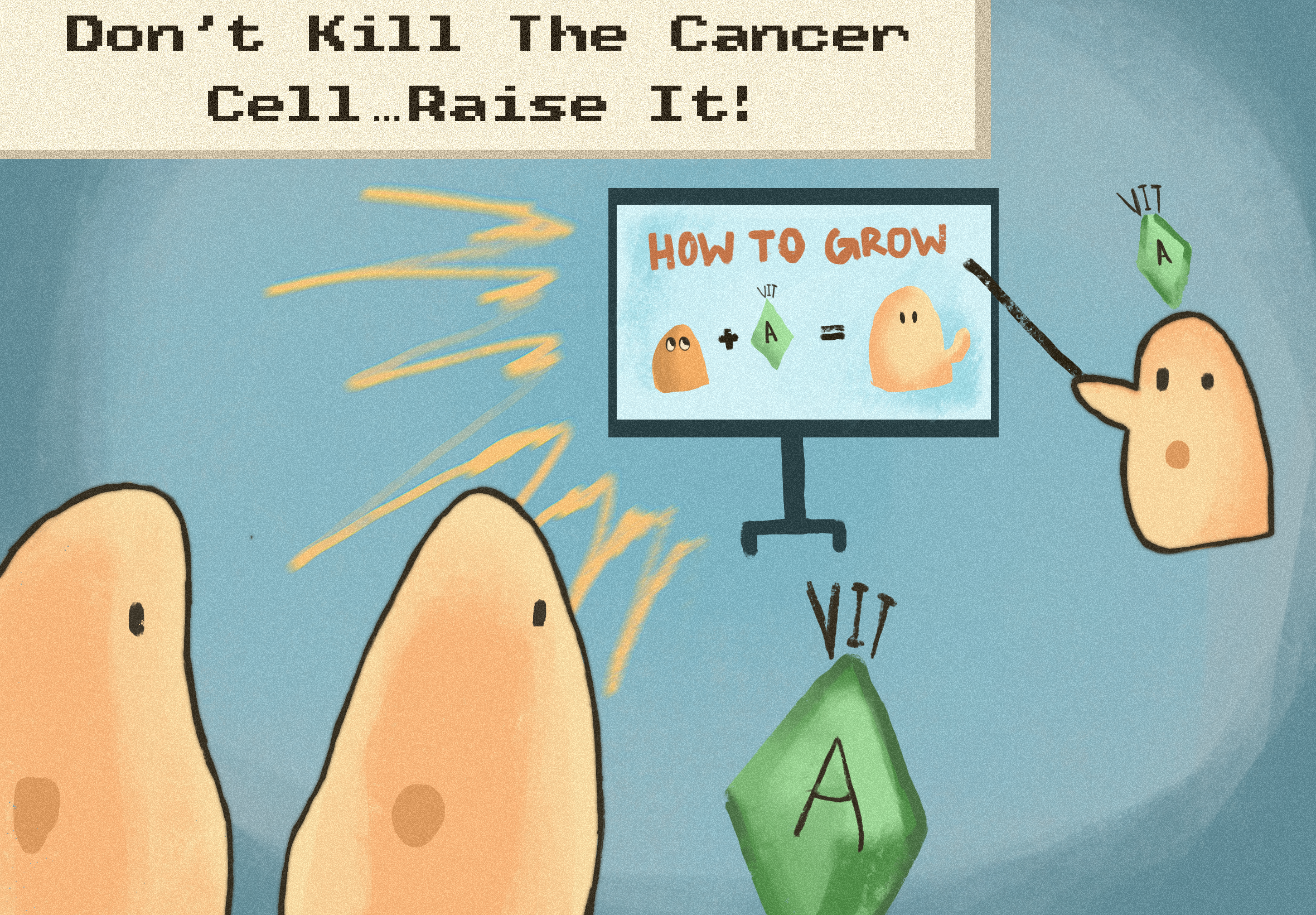
In your DNA, a gene creates a protein that acts like a switch. This protein’s job is to sit on your DNA and regulate the genes that help mature the cell by keeping the switch shut. When vitamin A arrives, that switch is flipped on and the cell is allowed to mature. What if that switch gets broken in half?
In APL, that’s exactly what happens. The chromosome holding that gene breaks, along with another chromosome, and the two swap pieces. The result is a hybrid chromosome that doesn’t naturally exist in anyone’s genome. During protein synthesis, the cell reads this hybrid and builds the new protein it codes for. That hybrid protein still sits where the original did, but now acts like a switch jammed in the off position without the ability to turn back on. It latches onto the genes the cell needs to finish growing up and recruits enzymes that envelop the DNA and pack it so tight that it can’t be read.
If a switch is jammed rather than destroyed, then there must be a way to force it to turn on. In 1988, a team in Shanghai’s Ruijin Hospital did exactly that. They gave 24 patients doses of a vitamin A derivative which was far more potent than anything that could be obtained from food. This derivative was able to attach to the hybrid protein and overwhelm it, prying the switch open. All 24 patients went into remission. Their cancer cells weren’t destroyed, they were just forced to grow up, do their job, and retire the way a normal cell does. The patients were spared the destruction of their bone marrow caused by traditional chemotherapy.
But the leukemia came back. Within months, it returned in a third of the patients. The scientists realised that forcing a jammed switch open does nothing to the thing that jammed it in the first place.
Fortunately, the answer to this problem already existed, coming from two thousand kilometres north. Arsenic, commonly known as a poison, is also an active ingredient in Pishuang, a preparation used in Chinese medicine for roughly two thousand years. In the early 1970s, Zhang Tingdong and his colleagues at Harbin Medical University worked through each ingredient of this folk remedy for cancer. They found that arsenic was doing all the work, and it worked best for one disease in particular, the same leukemia being treated in Shanghai. It took decades to work out the molecular process behind this unlikely treatment. Arsenic doesn’t pry the switch open, it removes the cause for the jam by binding to the hybrid protein and marking it for destruction. Together, they attack the same culprit from both ends, and leukemia runs out of ways to continue.
By 2013, the two drugs were tested together as a first treatment, with no chemotherapy at all. A European trial found it to be better than the standard chemotherapy program, with better overall survival and less toxicity. A cancer that could kill within days of diagnosis is now one of the most curable forms of acute leukemia, with long-term survival over 90%.
However, that number comes with an asterisk. The stuck cells also disrupt the blood’s clotting mechanisms, and patients bleed. In experienced trials, mortality rates are low, but across whole populations, it increases to about 30%. The medicine is almost solved. Getting it to people in time is not. APL is also a special case, driven by a singular faulty protein that both drugs hit directly. Most cancers aren’t.
Still, neither drug was invented to kill cancer. One is a form of vitamin A your body already makes, the other a poison that has been in use for two thousand years. Useful ideas rarely arrive from where we’re looking, and they rarely arrive whole. The cells were never broken. They just needed some ingenuity to finish growing up.