
The Illusion Of Stability
How neuroplasticity reshapes the brain, and the person you become.
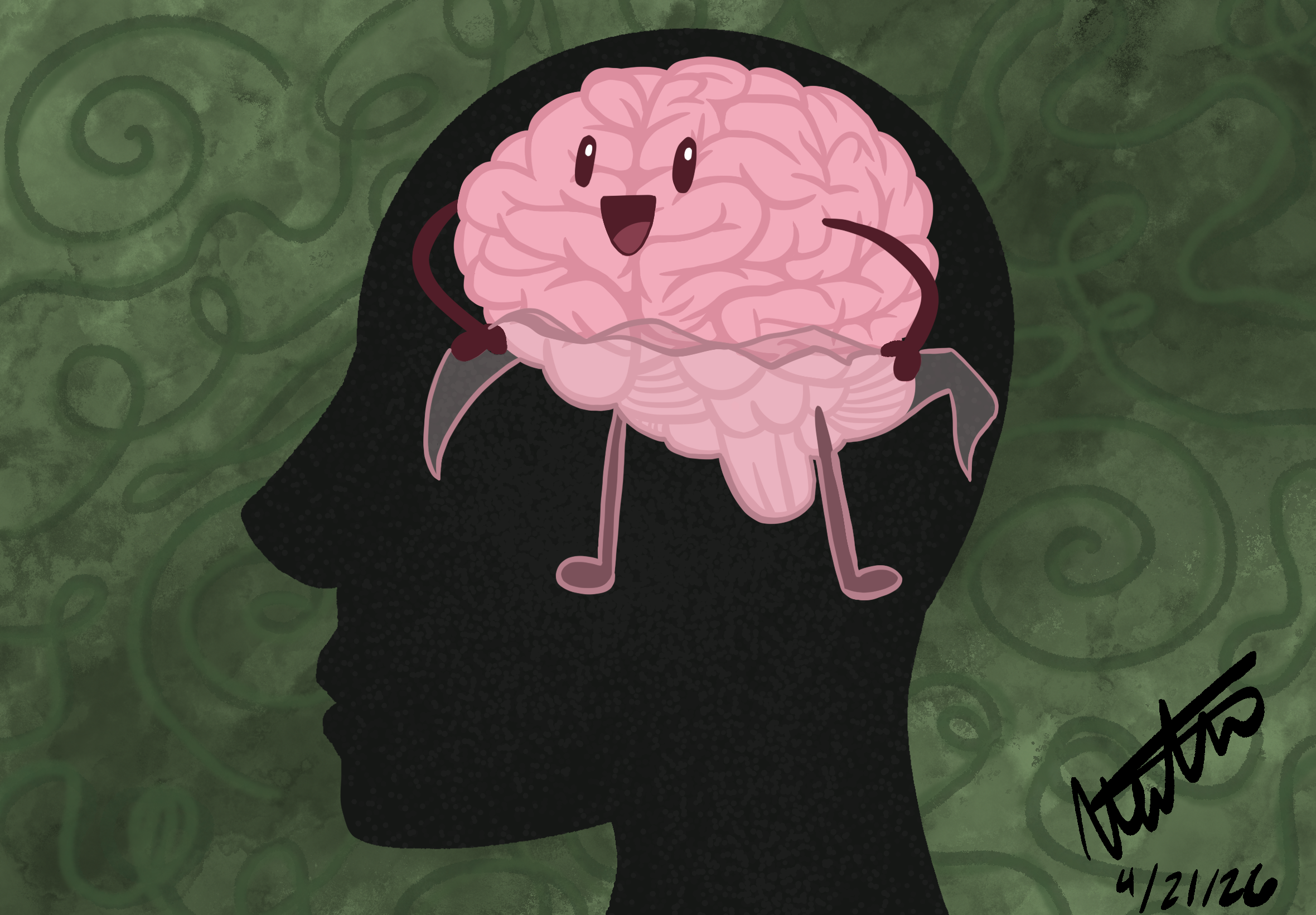
Graphic by Nalani Wooton
In a famous interview at the 2026 Winter Olympics, skier Eileen Gu said: “with neuroplasticity on my side, I can literally become exactly who I want to be.”
Our brains are made up of tiny cells called neurons. These communicate with each other through connections called synapses. Learning a skill or performing an action activates a group of neurons to form a neural pathway. When a neural pathway is used more frequently, the connections between neurons become more efficient, allowing signals to travel faster.
This is where repetition comes into play. The more a pathway is activated, the more deeply it becomes ingrained. On the other hand, pathways that are rarely used become weakened and fade away over time, making those skills difficult to access. Neuroplasticity allows you to literally “build your brain like a muscle” as Gu said. A well-known study by Maguire et al. showed that London taxi drivers had measurably larger hippocampi than non-drivers, primarily due to the effects of repeated navigation. The hippocampus is the brain region involved in spatial memory.
Neuroplasticity suggests that we are not chained down by the genes we are born into or the world we inherit. Psychology Today defines neuroplasticity as “the brain’s capacity to continue growing and evolving in response to life experiences.” Our bodies are in a constant state of flux, and the brain is no exception. Rather than functioning as a fixed control center, it is continuously being reshaped by experience and conscious thought.
You can deliberately shape the person you want to be. By choosing to reinforce the correct pathways, you can influence the kind of person you become. On the other hand, the brain cannot distinguish between what is useful and what is merely frequent. It only recognizes what is repeated. Replaying pessimistic thoughts, reacting badly to stressful situations, worrying about little things; these are also forms of repetitions. You are training your brain to resort to the same incorrect patterns, whether you mean to or not.
This is not just a theory about habits but also has real, clinical implications. Research by Seng et al. has shown that the ability of the brain to rewire itself holds significant implications for developmental sciences, neurological recovery and medical rehabilitation. Neuroplasticity is the reason recovery from brain injury is possible. For example, stroke patients can relearn how to speak or move by repeatedly activating those neural pathways. A study conducted by Landsmann et al. showed that stroke patients who underwent physical therapy had increased brain activity in the regions associated with movement and control. Therefore, physical therapy induces neuroplastic changes that contribute to overall recovery.
Parkinson’s disease is a condition where neurons progressively deteriorate. In this case, neuroplasticity cannot recover what has been damaged but can work around the loss. Surviving neurons are able to compensate for this by forming new connections or increasing the delivery of neurotransmitters, the chemicals responsible for delivering information from one neuron to the next. This allows alternative pathways to maintain function even as the disease progresses. The brain adapts, but within the boundaries set by biology.
In some cases, neuroplasticity can reinforce dysfunction rather than correct it. Chronic pain, for example, can persist even after an injury has healed, sometimes with no identifiable cause. This is because the brain has functionally reorganized its neural pathways to support maladaptive pain processing. The brain, in effect, learns the pain. Neuroplasticity focused treatments like brain stimulation and exercise-based therapies can act as potential interventions for such negative changes.
Thus, neuroplasticity does not mean we can instantly become whoever we choose. It means that who we become is shaped by what we repeat. The brain is constantly adapting, not to who we intend to be but to what we consistently do. In that sense, identity is not something we decide on, but something we practice into existence.
These articles are not intended to serve as medical advice. If you have specific medical concerns, please reach out to your provider.