
Endometriosis may not be the end.
Researchers are working to create human ovaries, but how close are we?
Graphic by Lauren Lu
When it comes to reproducing as a species, human females are born with all the eggs they will ever have in their lifetime. When a baby girl is born, she has approximately 1 to 2 million eggs in her ovaries. Each egg is stored in a fluid-filled structure called a follicle. Each month that passes before puberty, she loses 10,000 eggs. At puberty, she has 300,000-400,000 eggs, and the monthly loss slows down to 1,000 eggs. But where do these eggs go?
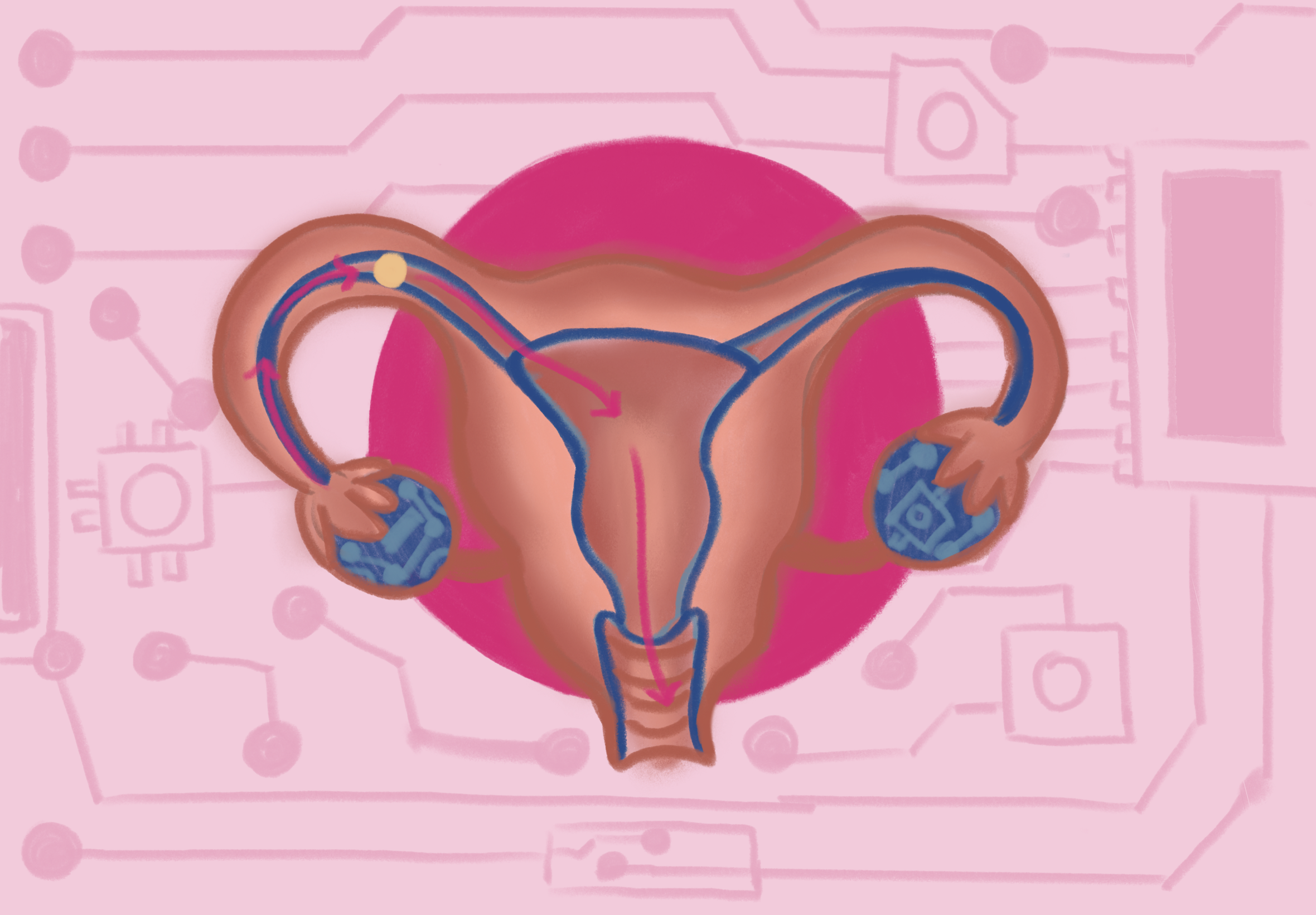
Ovulation is when eggs are released each month, and during this time, the eggs are released from the ovary into the fallopian tube, which is the pathway that connects the ovary to the uterus. They travel through the fallopian tube, into the uterus, and await fertilization. This whole process takes around 12-24 hours. While this process sounds like magic, the machinery can be harmed by conditions like Polycystic Ovary Syndrome (PCOS), a hormonal disorder, and endometriosis, an abnormal tissue growth.
PCOS is a common hormonal disorder affecting 5-13% women of reproductive age. It includes irregular periods, elevated androgen (male) hormones, and enlarged ovaries with small follicles. It is the leading cause of infertility. Its exact cause is unknown, but it is thought to be a mix of genetics, hormones, and lifestyle.
Endometriosis is when the cells similar to the lining of your uterus grow outside of the uterus. It can cause painful periods and infertility. As with PCOS, its exact cause is unknown, but it is also thought to be a mix of genetics, hormones, and lifestyle.
The female reproductive system has typically been treated with a one-size-fits-all approach. There are many generic hormonal birth control methods, when in reality, hormones vary widely between women and require a more personalized approach.
As a result, these disorders remain difficult to treat, largely due to a lack of comprehensive data, until recently.
In 2024, researchers at the University of Michigan successfully created an “atlas” of the cells in the human ovary. They did this by analyzing RNA in the tissues of five deceased donors. By doing this, they identified the genetic pattern required to develop healthy follicles.
This information not only provides us with a better understanding of the ovaries but could also serve as a potential blueprint for building an artificial ovary. Current methods for people who have lost ovarian function include freezing eggs prior to treatment or reimplanting pre-frozen tissue. Neither of these can guarantee a healthy pregnancy.
In addition to the Michigan researchers, the University of Oxford has created a map of the endometrium, the lining of the womb. The Michigan researchers plan to map other parts of the female reproductive system, including the uterus and fallopian tubes, to build a better understanding.
Even though the journey from an atlas to a functioning artificial ovary is complex, we now hold powerful data. For millions facing infertility or reproductive disorders, such research lights a path, offering new hope for a future where reproductive health is guided by science, not uncertainty.
These articles are not intended to serve as medical advice. If you have specific medical concerns, please reach out to your provider.