
Why you matter: A Crash Course on the Higgs Field
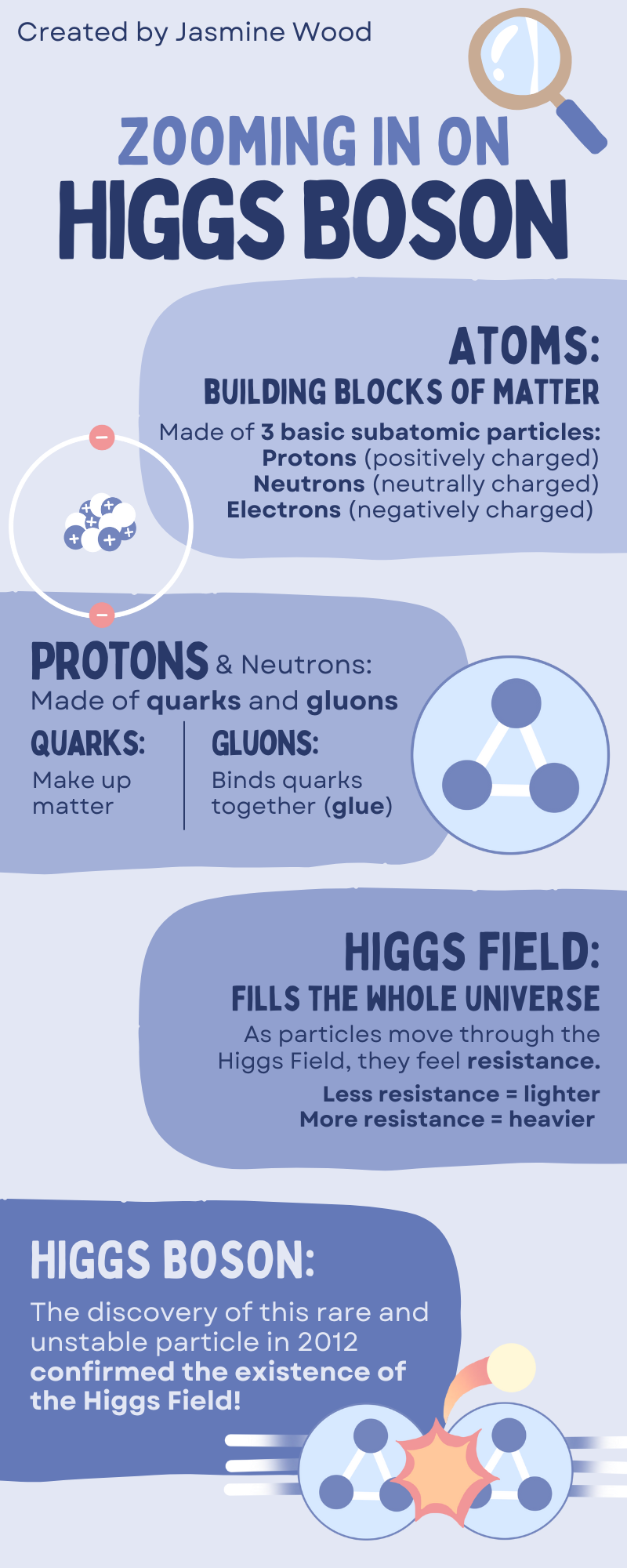
Written by: Riley Bruner | Edited by: Selina Hui | Graphic by: Jasmine Wood
There is an unseen emptiness that permeates the whole of the universe. Everyone you have ever hugged, kissed, or spoken to is 99.99% empty space. Even when humans embrace each other or our pets, we never truly touch them. But through observation, we know that matter undeniably interacts with its environment, no matter how empty it may appear.
The universe at its smallest scale is a terrifyingly unstable environment. If an atom were the size of a stadium, the nucleus would be the size of grains of sand at the To particles this small, spacetime itself can bend, warp, oscillate and stretch completely at random. Our human perspective shields us from this reality by averaging out a shocking amount of infinitesimal beads of charge, forming the elements and ultimately the world we interact with daily. At this level, the fundamental laws of physics can be thought of as acting like a large ocean, swirling around the particles. The heavier particles experience much more drag through this ocean; yet, the smallest particles, like photons, glide masslessly through.
The Higgs Boson is one of these elementary particles, though it is unique. It has zero spin – a property uncharacteristic of other fundamental particles. Through studying the decay of the Higg’s Boson, an event much like the death of a tiny star, we have seen interactions with other fundamental particles. This has given us some important insights in an underlying current which pushes mass onto particles.
The Higgs field is really just a measurement of the charges of particles and their drag on this current. It’s the brief energy a particle gives off when its motion changes. The interactions of everything, in every atom, are measured through this field. Without the Higgs field, everything would move at the speed of light; there would be no atoms, no stars, no chemistry, only endless radiation speeding through a dark, structureless expanse.
The cool part about the Higgs Boson may well be the relative mystery surrounding it. We have observed interactions “forbidden” by our current model; through studying the decay of the Higgs Boson, we may find new particles that explain these measurements. The Higgs field may also help us understand dark matter. We know that dark matter has mass, and we know that to have mass, a boson must show up when measured in the Higgs field. Understanding this interaction is a step towards understanding the properties of dark matter.
On the atomic scale, this resistance gives rise to everything that chemistry depends on. Electrons are drawn toward nuclei yet never fall in, trapped in shimmering probability clouds that define the boundaries of matter. The Higgs field gives the particles within atoms their mass, and that mass anchors the architecture of the periodic table itself. It determines how tightly elements bond, how metals conduct, and how molecules vibrate in just the right ways to make life possible. Without mass, there would be no orbitals, no molecular bonds, no materials to touch or transform.
These articles are not intended to serve as medical advice. If you have specific medical concerns, please reach out to your provider.