
Bridging Binary and Brain Cells
How the rise of AI-powered brain-computer interfaces might transform medicine and humanity
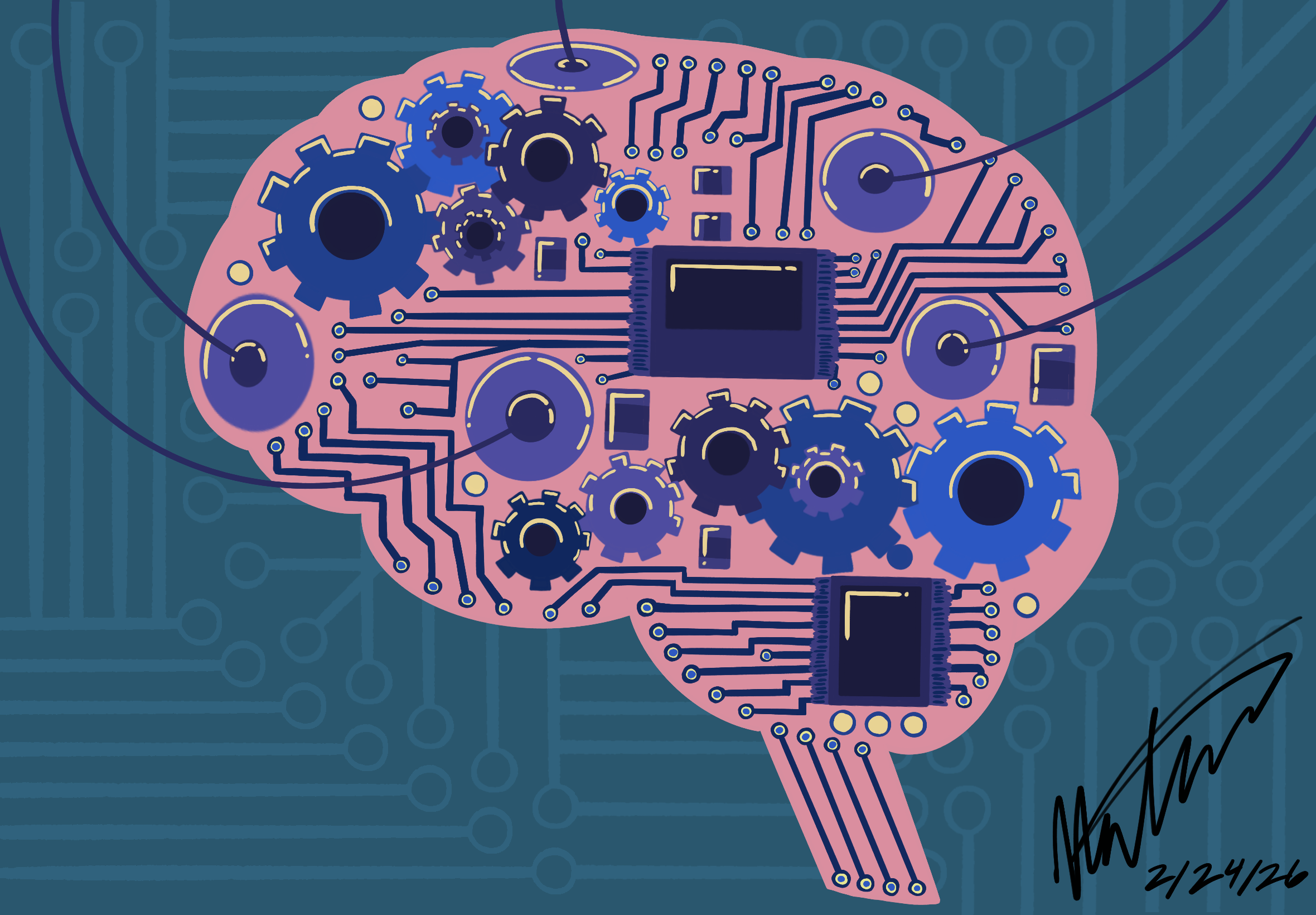
Graphic by Nalani Wood
In 2021, a devastating motorcycle crash left military veteran RJ paralyzed from the neck down. Unable to even scratch his own nose, a split-second incident pushed RJ into what he thought would be a lifetime of dependence. Fortunately, a revolutionary surgery at the University of Miami changed his life.
After a team of surgeons implanted him with a Neuralink brain-computer interface (BCI), RJ found himself able to control his phone and computer with merely his own thoughts. Today, research labs and companies around the world are racing to integrate artificial intelligence (AI) into BCIs to transform the livelihoods of individuals with severe brain and spinal cord injuries. But is there more to this unbelievable miracle promised by AI-BCIs?
BCIs are biomedical technology systems that can directly communicate with the central nervous system, allowing individuals with neurodegenerative diseases to achieve mobility and improved communication. All BCIs fall into one of two different general categories of implementation: noninvasive and invasive (such as Neuralink). Invasive methods involve directly implanting electrodes into brain tissue, and they are generally associated with high risks and complex surgical procedures.
On the other hand, non-invasive BCIs measure and interpret brain activity through safer, exterior methods. They rely on a variety of brain-imaging processes such as electroencephalography, functional magnetic resonance imaging, and more. When neurodegenerative diseases leave the brain and body unable to communicate, BCIs operate as a translator; they read and record brain signals, interpret their meanings, and write back commands to the brain to force activity.
So, where exactly does AI play a role in this process? For BCI’s, interpreting brain signals involves a high quantity of data, including pulse durations, electrical states of neural tissues, and stimulation frequencies. AI assists in processing and classifying data to interpret what the brain is trying to communicate with the body. While BCIs on their own can accomplish brain signal processing and translation, AI copilots dramatically improve the effectiveness of BCIs by analyzing past movements to predict the patient’s future movements and goals. In fact, a 2024 study at the University of California, Los Angeles found that paralysis-patients given an AI-BCI system were 3.9 times more accurate in manipulating robotic arms and cursors than those with simple BCIs. While originally inspired by neurons and neural networks, AI today plays an important role in the advancement of BCIs and neurological research.
While AI-BCIs show promising results, the junction of artificial and natural intelligence presents ethical concerns. Although dozens of individuals have undergone clinical trials for a variety of AI-BCIs, the long-term effects of these interfaces on mental and cognitive health are yet to be understood or explored due to the novelty of the field. And with the rapid growth of AI-BCI companies, such as the OpenAI-backed Merge Labs, already-lacking regulatory legislation and a deficit of longer-term studies may be unable to keep up with corporate progress. An additional ethical concern lies in the vast amount of sensitive neural data that BCIs collect: a lack of transparency on who can access and manipulate this data leads to serious security and privacy concerns.
AI-BCIs may grant patients suffering the worst of diseases a whole new life. With the power to revitalize the sensitive, vital link between the brain and body, AI-BCIs are dramatically transforming the field of biomedical technology. Despite the brilliant impacts this technology has made on people like RJ, unregulated and under-researched BCIs may bring about disastrous consequences over the long run. Through improved legislation and initiatives to support long-term research, BCIs may truly bring back the voices and abilities of millions.
These articles are not intended to serve as medical advice. If you have specific medical concerns, please reach out to your provider.