
Subduction Zone Death: A New Era of Tectonics
How a groundbreaking geologic event might transform the world as we know it
Written by: Somya Mehta | Edited by: Morgan Nguyen | Infographic by: Jasmine Wood
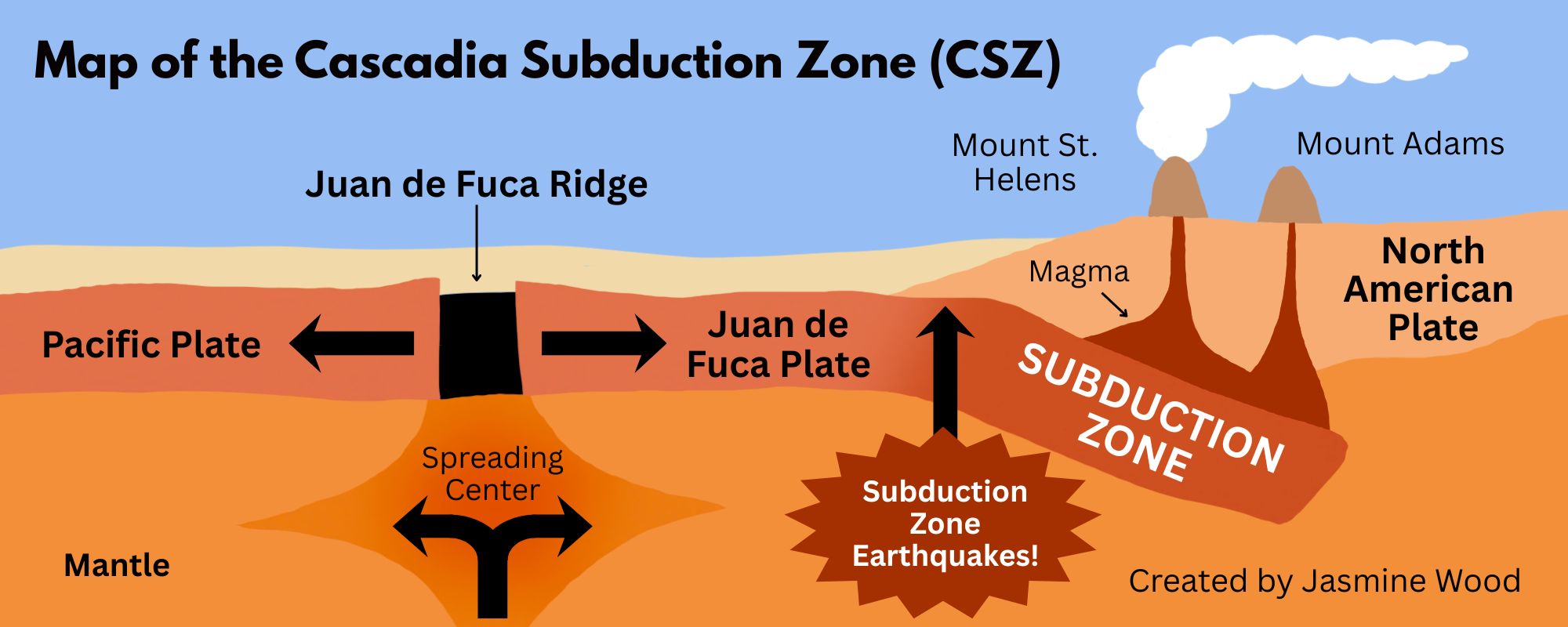
Slab pull is a force strong enough to unite tectonic plates, carve out deep-sea trenches, and initiate the violent chains of energy transfers that produce powerful earthquakes. Slab pull is the force that drives subduction zones, regions where cooler, denser plates get pulled under their less dense neighbors. Yet, scientists are observing an unusual pattern that may counteract the intense magnitude of slab pull. Right off the coast of the Americas, a never-before-seen phenomenon is taking shape: the death of an entire subduction zone system.
The Cascadia Subduction Zone (CSZ) stretches from Northern Vancouver Island down to Northern California. In this region, the Juan de Fuca tectonic plate is subducting (being pushed underneath) the North American plate in a unique manner. This region is capable of producing mega-earthquakes above a rare 8.5 magnitude, with a geologic history of at least seven megathrust earthquakes over the past 3,500 years. What makes the CSZ unique from other subduction zones is its ongoing destruction.
A study led by geophysicist Brandon Shuck at Louisiana State University presents strong evidence documenting the gradual termination of the CSZ. New seismic images and earthquake catalogs suggest that tears are appearing in CSZ slabs, leading to slab detachment. One piece of compelling data maps seismic activity along the tear; some sections along this region have gone quiet, experiencing no earthquakes, due to the complete detachment of rocks. Shuck says that due to the intense amount of energy needed to start a subduction zone, “Ending it requires something dramatic– basically, a train wreck”. So, what exactly is this train wreck that is actively destroying the CSZ?
The most likely explanation for slab-tearing and detachment involves mid-ocean ridges. Mid-ocean ridges are regions where new, warmer oceanic crust emerges. As the younger, warmer oceanic crust from these ridges approaches the cooler, older crust of subduction zone trenches, the colder slab detaches from the incoming warmer slab, leading to slab tearing and a decrease in the slab-pull force that drives subduction. Scientists believe that the termination of the Farallon subduction zone in North America during the Cenozoic era occurred in a similar way, although a poor geologic record makes it difficult to understand the exact sequence and dynamics involved with these events. The tearing of the Juan de Fuca plate may therefore be explained by its proximity to a mid-ocean ridge.
Changes in the CSZ affect more than just its own surrounding area. A research paper led by OSU professor Chris Goldfinger reveals that the Cascadia faults and the San Andreas Fault (a major transform fault running through California) produce synchronized earthquakes. Northern San Andreas Fault events trigger events in the Cascadia subduction zone, and vice versa.
Goldfinger’s team took core samples and analyzed turbidites, deposits formed by submarine landslides triggered by seismic activity, such as earthquakes. Samples taken from Northern California contained two beds of turbidites; the lower layer was finer-grained, while the upper was coarser. The close proximity of these two beds revealed that two seismic events in the CSZ and the San Andreas Fault occurred at similar times. For example, it is predicted that the 1700 CSZ earthquake (a megathrust earthquake) occurred within the same year as another earthquake caused by the San Andreas Fault. This creates implications for residents affected by San Andreas seismic activity. It is not yet fully understood how the CSZ’s future tectonic evolution will affect its relationship with seismic activity from the San Andreas fault.
These recent findings concerning the destruction of the CSZ are accompanied by doubts about the future of tectonic activity in the Americas. While areas where slabs are split will experience little seismic activity, not much can be said about surrounding regions. The ongoing observance of a destructive subduction zone ushers in a new era of geology, one that analyzes unprecedented forces shaping our planet.
These articles are not intended to serve as medical advice. If you have specific medical concerns, please reach out to your provider.