
Lab-Grown Body Parts - Organoids
Written by: Lara Sadi | Edited by: Ziona Somy | Infographic by: Fernanda Rodriguez
The idea of looking into a petri dish and seeing the equivalent of a tiny human brain sounds straight out of a science fiction movie. Yet today, scientists around the world are doing exactly that, growing miniature organs that somehow mimic the ones in our body on a microscopic scale. These carefully crafted, tiny living models called organoids are shaping the future.
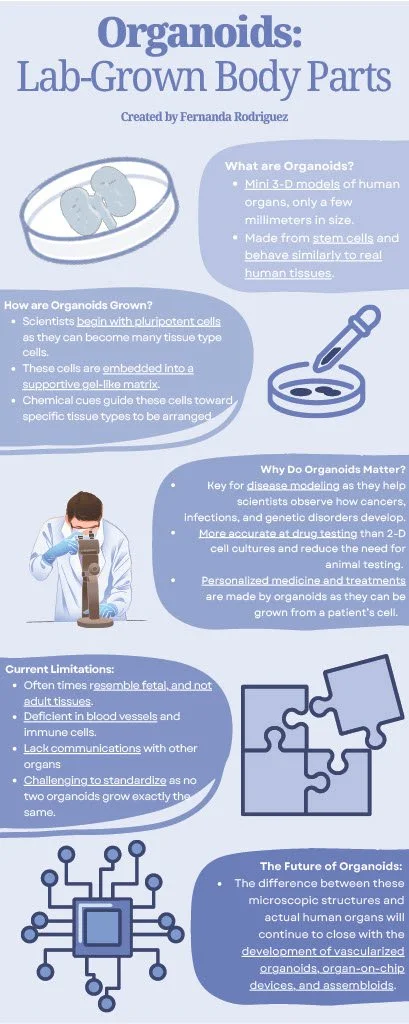
By using stem cells’ ability to transform into many different types of tissue, scientists create organoids. Scientists guide stem cells in a three-dimensional culture environment to self-organize by giving them specific signals. This lets them differentiate and develop into cell structures that resemble real organs. These cells can arrange themselves into miniature copies of organs such as the brain, kidney, liver, lungs, or even the retina when presented with the right signals. Compared to traditional flat (2D) cell cultures, organoids behave far more like actual human tissues, even though organoids are typically just a few millimeters in size. They retain many of the same internal structures, proteins, and DNA as the organs they mimic. According to studies, organoids are significantly more accurate for scientific research because they retain key traits from the tissues from which they derive, such as genes, expression patterns, and genetic mutations.
So why are organoids so important for modern medicine? Thanks to the discovery of organoids, scientists can observe human biology in ways that were previously impossible. Since organoids act like miniature models of human organs, researchers can now clearly study and observe how diseases develop, test new medications with greater accuracy, and even create personalized treatments based on a patient’s own cells. They offer insights into infections and genetic disorders, a safer, more accurate alternative to animal testing, and assist scientists in investigating new approaches to tissue repair or conservation. Organoids, such as intestinal organoids, have fundamentally changed how we understand, treat, and research disease by providing a minimally invasive window into the inner workings of the human body. Intestinal organoids are three-dimensional structures that “recapitulate the identity, cell heterogeneity and cell behaviour of the original tissue in vitro. This includes the capacity of stem cells to self-renew, as well as to differentiate towards major intestinal lineages.”
Even though they have great potential, organoids are not perfect. Current models have been found to inaccurately reflect the function of mature organs, as they typically mimic fetal rather than adult tissues. Additionally, many organoids lack immune cells, blood vessels, and the organ-to-organ communication that occurs in the body. This restricts the length of time they can be developed and the accuracy with which they replicate human physiology.
Another challenge is the replicability of organoid experiments. Because organoids self-organize, it has been challenging to standardize experiments, as no two organoids are identical. To increase consistency of organoid growth, scientists are now creating more advanced techniques, including designed scaffolds and controlled bioreactors.
Organoids have already transformed modern biology, despite their current limits. They enable scientists to investigate developmental processes, test medications, simulate illnesses, and customize therapies in a much more realistic way. The difference between these microscopic structures and actual human organs will continue to close as technology advances, particularly with the development of vascularized organoids, organ-on-chip devices, and assembloids.
These articles are not intended to serve as medical advice. If you have specific medical concerns, please reach out to your provider.