
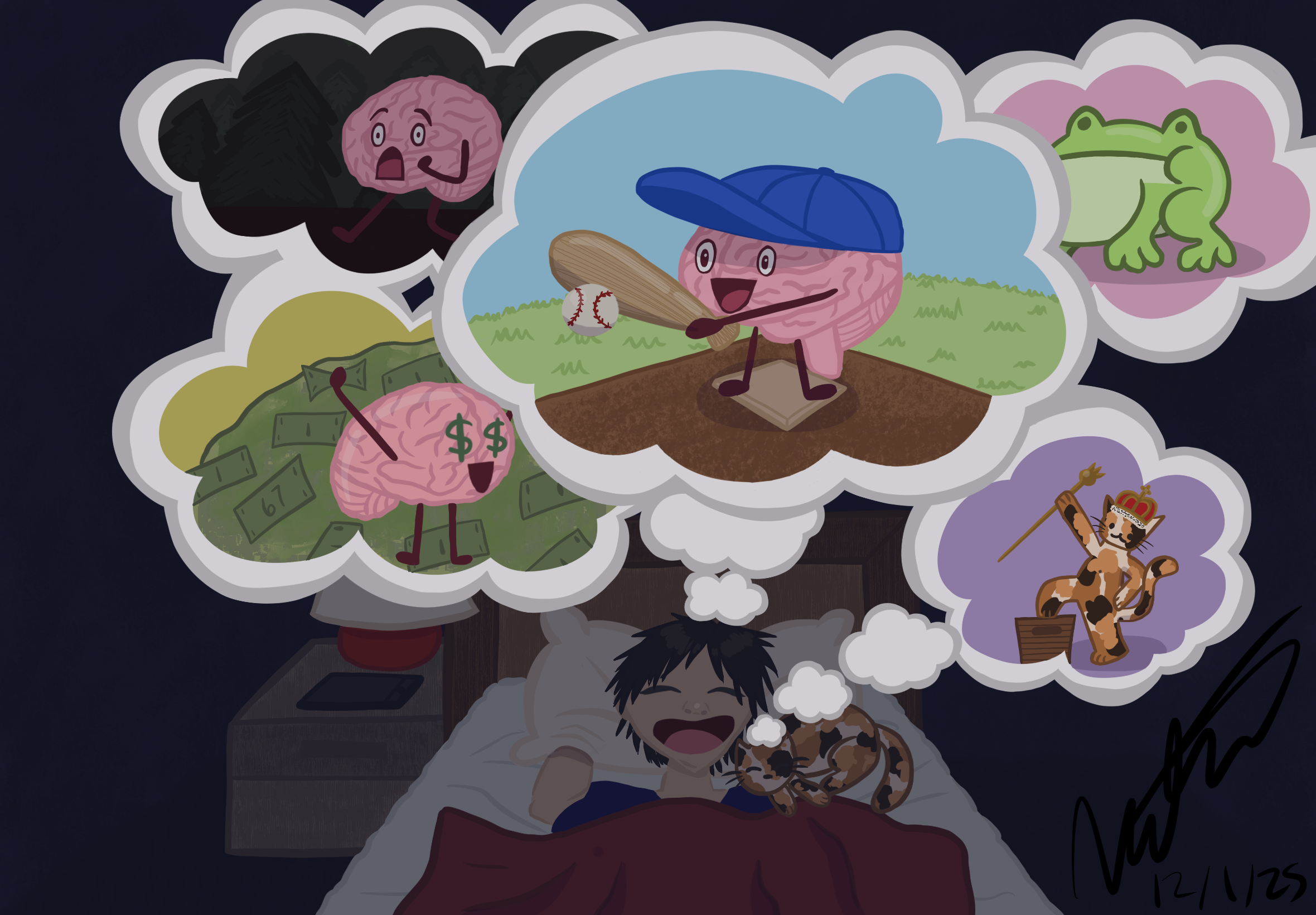
Healing Through Lucid Dreaming
Can intentional lucid dreaming offer a new approach to healing PTSD symptoms?
Written by: Elle Scord | Edited by: Sanjna Sunil | Graphic by: Monna Wei
Have you ever had a dream so intense that it felt like a past memory? For many people with PTSD, that feeling isn’t imagined. These nightmares aren’t just frightening—they’re the brain’s way of replaying trauma on an endless loop.
According to sleep researcher Anne Germain from the American Journal of Psychiatry, up to 75% of people with post-traumatic stress disorder struggle with recurring nightmares, most often tied to their original trauma.
Post-traumatic stress disorder (PTSD) is a mental health condition that can develop after a person experiences a traumatic event, and it often comes with symptoms such as intrusive memories, heightened vigilance, and, for many people, disturbing dreams that reflect their fear of the past.
These nightmares are not just disturbing; they have also demonstrated trauma’s ability to reshape the brain and disrupt normal emotional processing pathways. Specifically, neuroscience research shows that trauma alters the pathways connecting the brain’s emotional and reasoning centers. This imbalance is reflected within nightmares: the amygdala and hippocampus — brain regions involved in fear and memory — become highly active, while the rational centers of our brain, such as the prefrontal cortex, fail to regulate this surge. As a result, the brain continues to replay frightening memories rather than working through them.
There are many approaches to treating PTSD; however, the most commonly used is a psychotherapeutic intervention known as Cognitive-Behavioral Therapy (CBT). CBT works by leading patients to gently confront their trauma and reconstruct their negative thought patterns by replacing them with more balanced and supportive ones.
Even still, CBT often has high dropout rates and provides lasting benefits for only 50% of patients. Additionally, waking therapy can only do so much when it comes to how individuals process their trauma during sleep. Even with therapy, many people continue to face the same nightmares, leading researchers to ask a question that could reshape the future of PTSD therapy:
What if, in the middle of one of these nightmares, the dreamer suddenly became aware that they were dreaming and could actually change what happened next?
This experience is known as lucid dreaming, a state in which an individual becomes aware of the fact that they are dreaming as the dream is still unfolding. In some cases, this awareness can even allow the dreamer to actively influence what happens in real time.
Typically, we can't consciously control what we dream about. However, the moment someone recognizes a dream for what it is, the brain gains a surprising degree of control — sometimes enough to shift the course of a dream entirely, transforming a distressing scenario to one where they feel safe.
Ongoing research suggests that lucid dreaming may offer a unique opportunity to explore the healing potential of the dream state. During the REM stage of the sleep cycle, there is increased neural activity in the prefrontal cortex in addition to increased communication between the frontopolar cortex (frontmost part of the brain) and temporoparietal regions (areas along the sides and upper back regions of the brain). Hyperactive communication between these regions is theorized to provide a mechanism for metacognition during the dream state. By revisiting and restructuring traumatic memories in the dream state, there may be potential for individuals to decouple their memories from an intense stress response.
Although lucid dreams often occur spontaneously, they can also be induced by the dreamer themself through various techniques. In a recent study, participants who completed a six-day lucid dreaming workshop showed substantial and lasting improvements in PTSD symptoms. Although the study didn’t find a significant correlation between the frequency of lucid dreams themselves and direct symptom reduction, this suggests that engagement with the dream state, whether or not lucidity is actually achieved, may play an important role in trauma processing.
While the emerging science suggests that lucid dreaming may offer a new treatment approach for trauma responses related to PTSD, whether intentionally inducing lucid dreams can reliably reduce PTSD symptoms remains a complex topic with an unclear answer. By increasing awareness within the dream state, lucid dreaming could help to lessen the hold of traumatic nightmares in ways that waking therapy alone cannot.
However, the science in this discipline is early, and it currently remains unclear whether lucid dreaming could reliably reduce PTSD symptoms. What is clear is that the dream state, along with lucid dreaming induction techniques, may hold far more therapeutic potential than previously imagined.
These articles are not intended to serve as medical advice. If you have specific medical concerns, please reach out to your provider.