
Balancing an Invisible Ecosystem
The science behind cycling aquariums.
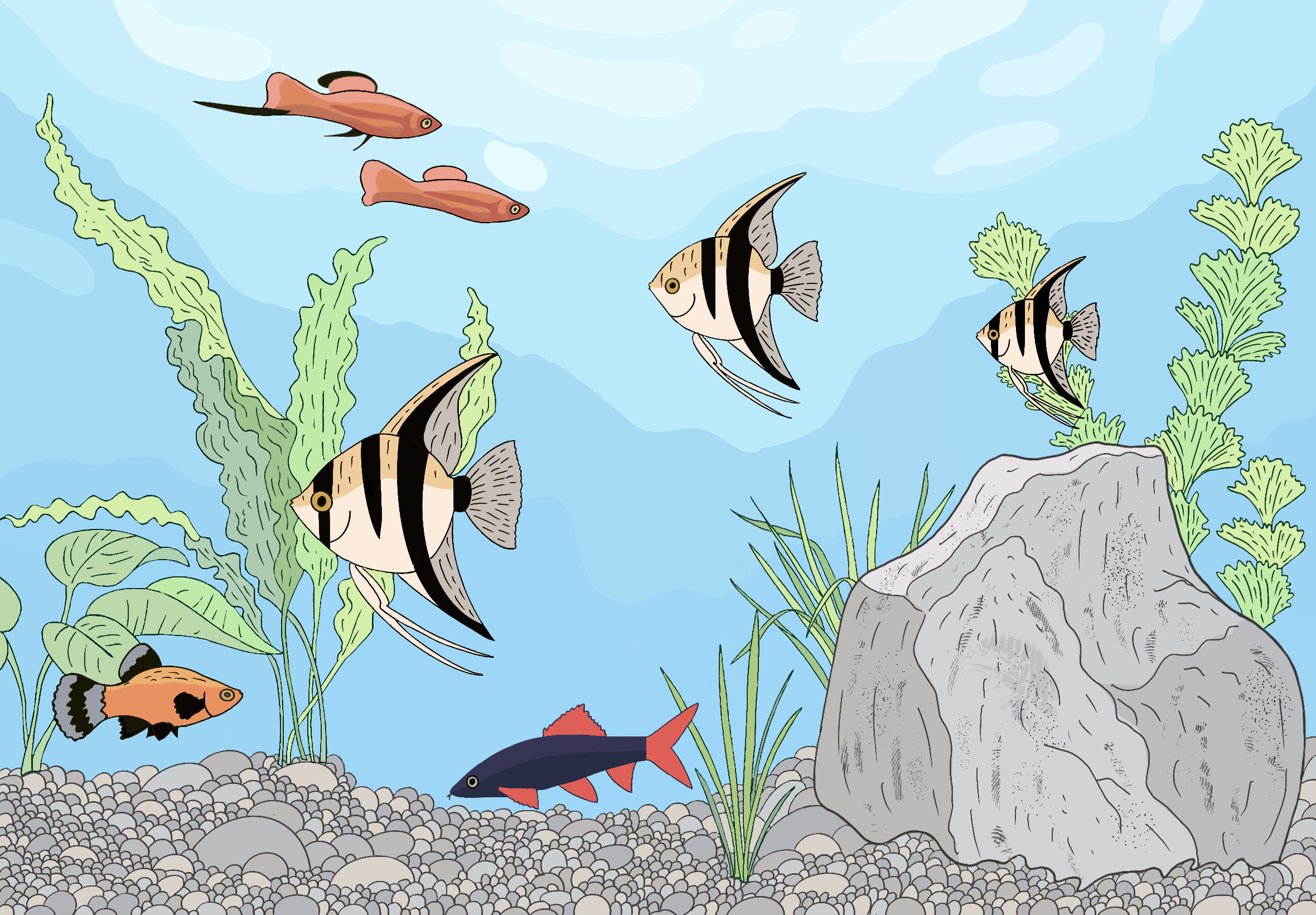
Graphic By Mariana Drove
Despite having the reputation of being an easy pet to own, did you know that there is actually a lot of science behind successful fishkeeping? Freshwater aquariums are often seen as simple environments for fish to live in, but they are also ecosystems that sustain billions of microorganisms that go unseen.
Unlike natural bodies of water, aquariums are closed ecosystems, which means that all the waste that is produced by the fish, or even from overfeeding, has nowhere to go. Any waste produced in an aquarium will quickly decompose in a process that builds toxic compounds that can build to dangerous levels if left unchecked. To prevent this, one must “cycle” their tanks before adding any fish in.
Cycling an aquarium is the process of adding organic matter, such as fish food or chemical-grade ammonia, to establish beneficial microbial populations that are capable of supporting the bioload of whatever aquatic life may find themselves in that aquarium.
At the most basic level, cycling an aquarium refers to the development of nitrifying bacteria that convert nitrogenous waste into less harmful substances through the nitrogen cycle. The nitrogen cycle converts toxic ammonia nitrites to a less toxic form and then into nitrates. Nitrates are relatively safer for fish at low concentrations. Ammonia becomes toxic to fish at levels over 2 parts per million (ppm), and can begin rising within a few days in an uncycled tank. Nitrites usually begin rising within the first week of adding fish to an uncycled tank, and can harm fish at levels as low as 1 ppm. Nitrates are not very toxic to fish at low to moderate levels.
The cycling process occurs in stages. In the first stage of cycling an aquarium involves Nitrosomonas bacteria oxidizing ammonia into nitrite. This process involves oxygen, and while it does reduce ammonia levels, it does not reduce the concentration of the almost-as-toxic nitrites. The second stage of the nitrogen cycle involves a different type of bacteria, Nitrospira, which significantly reduces the toxicity of the tank waste by converting nitrites to nitrates.
Although these nitrates are far less toxic to aquatic life than ammonia or nitrites, they are still harmful, especially at higher concentrations. Because of this, it is necessary to do “water changes” in an aquarium. Water changes involve removing a fixed percentage of the aquarium water on a regular schedule and replacing it with fresh, dechlorinated water to help remove accumulated waste. It is important to note that a water change is different from “topping up” the water level in an aquarium, as waste does not evaporate with the water.
As the aquarium, from the filter to the substrate, and even on the plants. This makes established tanks less prone to extreme fluctuations in water quality. This is why it is very difficult to keep fish healthy in a new tank, and why it is important to add inhabitants gradually.
Finally, monitoring water parameters is essential as it allows aquarists to track the stages of the cycle and determine when the process is complete. A fully cycled tank should show ammonia and nitrite levels of zero, with a minimal amount of nitrates present, even after starting the cycle with some fish food or lab-grade ammonia. Ultimately, the nitrogen cycle involved in cycling an aquarium shows just how involved the fishkeeping process is. The next time you want to get a pet fish, remember that you are responsible for maintaining not only the fish but an entire ecosystem of microorganisms as well.
These articles are not intended to serve as medical advice. If you have specific medical concerns, please reach out to your provider.