
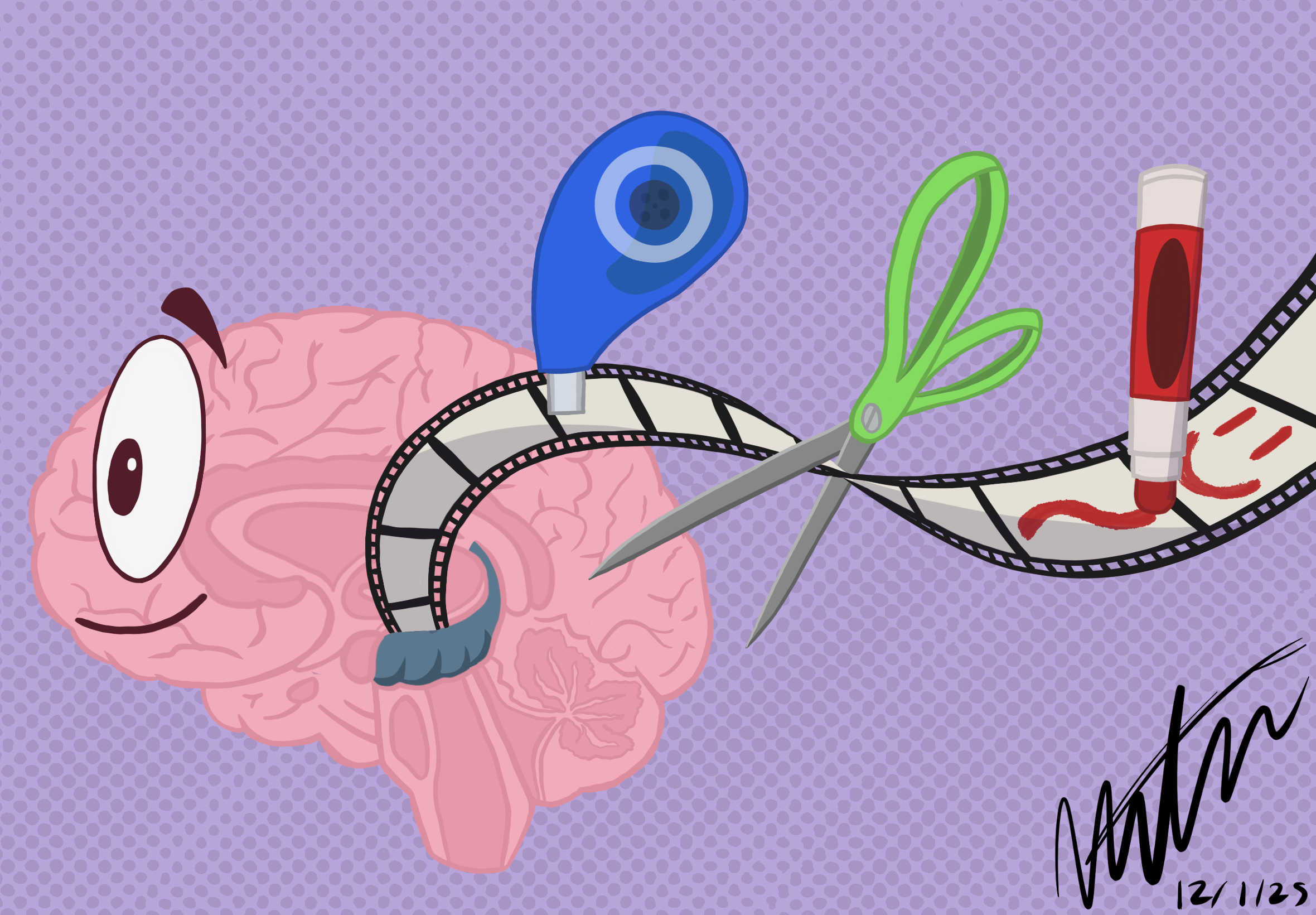
Engineering Memories:
How Science is Shaping Memories
Explore current breakthroughs and ethical concerns regarding the redesigning of memories.
Written by: Anjella Kang Lee | Edited by: Ruby Lee | Graphic by: Nalani Wooton
Have you ever remembered something differently from how others have? So who was right? Turns out, you may both be wrong. Many find themselves in situations in which their recollection of an event is completely different from how the other party remembers it. So, how reliable are our memories?
Studies have shown that memories naturally change from the moment information is collected, and are even deleted under certain circumstances. It is a natural phenomenon that memories change over time, even after just witnessing something. And no, it is not just someone being forgetful or uninterested; it is an actual phenomenon that we all experience.
The difficulty in retaining accurate memories is substantiated by the model of the “forgetting curve” hypothesized by psychologist Hermann Ebbinghaus, which models the loss of information. The curve shows that people cannot retrieve about half of the information they received after a single day. However, recent developments have enabled the artificial editing and removal of memories. These artificial techniques are referred to as memory modification technologies (MMTs). According to a study conducted at the Jagiellonian University in Krakow in 2021, MMTs can edit memories by interfering with one of two processes that result in the storing of memories: consolidation and reconsolidation. The process of interfering with memory consolidation involves preventing memories from forming in the first place, while preventing reconsolidation causes interference during a brief period after the memory is made. Though already established memories are difficult to alter or delete, there is a brief “window of vulnerability” that allows memories to be altered in the way they are remembered. The study indicates that alterations are conducted through the use of protein synthesis inhibitors, but due to their high toxicity, they are not being used in humans. Instead, other drugs that are human-safe have been experimented with, most notably propranolol.
The effects of propranolol, a drug that works by blocking hormones such as epinephrine, have long been studied. A study from 2007 published in the Journal of Psychiatric Research showed that taking propranolol after experiencing a traumatic event can decrease memory reconsolidation, although more research was said to be necessary to make more conclusive claims. Thus, ways in which memory formation can be altered are continuously increasing. Despite these significant advances, these developments inevitably lead to ethical concerns regarding memories and interfering with them. In particular, an article from the AMA Journal of Ethics discusses how critics argue that memories are invaluable in forming a person’s identity, and altering memories jeopardizes their individuality. It is clear that selective interference of memories requires many guidelines, and there are many factors and scenarios that pose moral challenges. For example, would memory modification be ethical in the context of trying to decrease suffering from a traumatic event? These are the types of questions that the guidelines must address.
Similar to other types of modifications, such as gene editing, memory modification practices also require the creation of ethical guidelines. Without these, it is impossible to know what effects this practice could have on society. Memories are critical in the formation of each person’s personality, thoughts, and behavior, and tampering with them should be done in ethical ways and come with a clear warning label.
These articles are not intended to serve as medical advice. If you have specific medical concerns, please reach out to your provider.