
The Science Behind Sourdough
How tiny organisms and simple chemistry create your favorite loaf
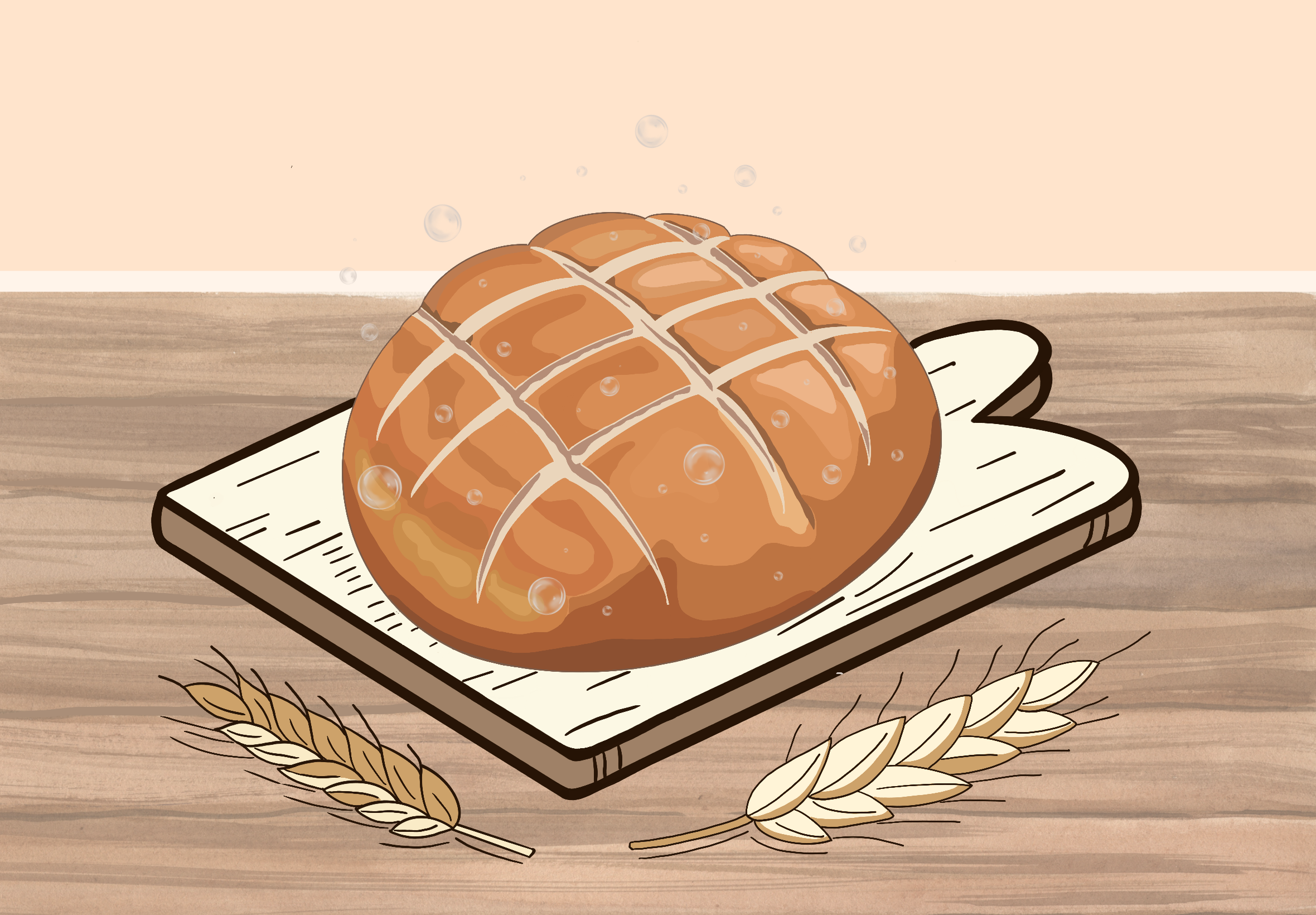
Graphic by Mariana Drove
During the 2020 coronavirus lockdown, many families gained an unusual family member: a jar of pungent, bubbling flour-and-water mixture that lived on the kitchen counter. The sourdough craze swept through the country during COVID-19, becoming both an escape from the harsh realities of the world and a way to occupy ourselves when we were stuck at home. What appeared to be a simple baking trend was actually a living science experiment that required daily care and attention. It was a daunting task that felt both like a prize and a challenge during months of isolation.
Bread, in its many forms, has been around for centuries. Sourdough itself has a storied history spanning thousands of years, with evidence dating back to ancient Egypt. Sourdough had been made long before we could look through a microscope and identify the organisms behind it. Before the development of commercial yeast, nearly all leavened bread relied on naturally occurring wild yeast, meaning that, for most of human history, all bread was essentially sourdough. Today, we know that it is a living mixture of yeast and bacteria that feed on different ingredients and grow, turning dough into bread.
It all starts with the sourdough starter. Similar to how humans produce carbon dioxide when breaking down sugars during cellular respiration, yeast in sourdough consumes sugars in the flour and releases carbon dioxide as a byproduct, which gets trapped in the dough, causing it to rise. At the same time, lactic acid bacteria grow in the mixture and produce acids that shape the bread's flavor and help preserve it over time. This combination of organisms gives sourdough its distinctive tang and differentiates it from modern industrial bread, which usually relies on a single species of baker’s yeast.
At first, the starter is kind of chaotic, with many different microbes present competing for the same resources. When flour and water are mixed, many different microbes appear and start feeding. These various microbes form an ecosystem within the dough. Over time, the lactic acid bacteria make the starter so acidic that they kill off many microbes, leaving only lactic acid bacteria and a few acid-tolerant yeast strains.
Even though the organisms develop as a whole, every starter has its unique balance of microbes. The balance depends on various factors, including the type of flour, how often the starter is fed, and the temperature and humidity of the surrounding environment. That is why many people can follow the exact same recipe, even with the same original starter, and end up with different-tasting loaves.
Flour choice matters a lot more than people expect. Most people assume that only the flour they use to make the dough influences the taste of the bread, but different grains have unique nutrients that select which microbes grow best. Hydration is also key: a thicker starter tends to produce stronger, sharper flavors, while a wetter starter tends to be milder.
Once the dough is mixed, its structure becomes important. Flour contains proteins called glutenin and gliadin. When they mix with water, they form gluten, creating a network that holds everything together by trapping gas, so the dough can rise rather than collapse. During the dough formation process, you do various stretches and folds periodically to help strengthen the gluten network. It makes the dough more elastic and better at holding its shape. Time also plays an important role. Letting the dough ferment longer gives the microbes more time to produce gas and acids, affecting both flavor and texture. The temperature of the environment also affects how active the yeast and bacteria are, further shifting the final bread's taste.
Then comes the baking. The heat causes the gas inside the dough to expand. The crust forms and browns through the Maillard reaction, which creates flavor and color. The Maillard reaction is the result of many small chemical reactions occurring simultaneously when the proteins and sugars in the dough are heated.
Sourdough might seem like a recent trend, especially after the pandemic, but it has been around for thousands of years, with the process remaining fairly constant. Bakers are still relying on the same basic interactions between yeast, bacteria, and flour. The only difference is that we can zoom in and see what happens behind the scenes.
My recipe, which was passed down from my high school chemistry teacher (everything can be customized to your liking):
First, the starter: You can make your own, but I recommend using some from a friend or a local bakery you like, which makes it more of a community project.
Feeding the starter: You can keep the starter in the fridge during the week and then pull it out whenever you want to use it, but make sure to feed it periodically and get rid of the excess (discard) to keep the starter healthy. I use rye flour, whole wheat flour, and bread flour in my main starter, which I keep in the fridge. You typically want a 1:1:1 ratio of starter, flour, and water for basic feedings, so for about 45g of starter, I usually use 5-6g rye, about 10-12g bread, and the rest wheat (with an equal mass of water).
Preparing the dough:
I feed it the night before, then take a 15g sample and feed that again early the next morning.
As it approaches doubling in volume, I prepare the autolyse with 400g of bread flour (oftentimes, I do a mixture of bread, whole wheat, and rye flour to get a different taste) and about 290g of water and work them together, then let it sit at least 15 minutes but as long as 60-90 minutes before adding the starter. If it’s not rising enough, it may be too cold in the environment. Try moving it somewhere warmer.
When the starter has doubled, or more than doubled in volume (I try to catch it while it’s still increasing), I add about 70g of it to the autolyse. Mix to make sure everything is incorporated.
Wait about 20 minutes, then add 8g salt (2% of the flour weight) and incorporate. Cover with a damp towel or plastic bag.
Let it sit for 30 minutes, then do the stretch-and-folds. Stretch and folds can be complicated; try finding a video online. Repeat at 30-45min intervals 3 more times.
Let the dough bulk rise until evening (a few hours).
Take it out of the bowl, then do one more stretch-and-fold to shape the dough. Let rest for a few minutes, then place onto a floured towel into an 8-9" bowl. Cover and place in the fridge overnight.
Baking the loaf:
The next day, preheat the oven to 500F. Place a Dutch oven in the oven to preheat as well.
Once preheated, remove the loaf from the fridge, place it onto a sheet of parchment paper, and score the top of the loaf.
Remove the Dutch oven from the oven, put the loaf in, and cover with the lid. You can lightly spray the loaf with water first. Cook for 21 minutes.
Remove lid and cook 21min at 425F.
Cool on a wire rack for at least an hour. Resting the dough is incredibly important because the inside is still cooking after you remove the loaf from the oven.
If it turns out great, congratulations! If it doesn’t, just try again and try to figure out what went wrong. A different recipe may work great for you, but not for someone else.
In contrast, passing by a display of packaged cookies in a grocery store is unlikely to evoke the same memory with nearly the same intensity.
So why is it that a single smell can transport us back in time with such emotional clarity, while sight or hearing does not produce the same effect? Although olfaction, the sense of smell, is often overlooked as a primary sense, it is uniquely connected to the brain’s systems for memory and emotion through neural pathways that differ from those of other sensory modalities.
The human nose contains thousands of olfactory receptors, each primed to detect specific molecular features of different odors. According to foundational work by researchers Haberly and Price, when activated, these receptors send signals to the olfactory bulb and onward to the piriform cortex, where smells are initially processed. From there, the information is transmitted to the amygdala, which plays a key role in emotional processing, and the hippocampus, which is essential for the formation of memories.
On the other hand, sensations such as sight and sound must first be relayed through the thalamus and cortex, which function as central sensory processing and rerouting hubs, before reaching higher cortical areas. This additional processing step indicates that these senses take a less direct route to the brain’s amygdala and hippocampus. Olfaction has a more immediate pathway to these regions, helping explain why smells can evoke especially vivid and emotionally rich memories.
A number of studies have experimentally investigated a phenomenon known as the Proust Effect, defined as the tendency for odors to evoke especially vivid, emotional, and autobiographical memories from the past compared to other sensory cues.
These studies indicate that one reason why these memories may feel especially powerful is that many of our earliest experiences are closely tied to smell. According to Herz and Engen, during childhood, the brain is still developing sensory and emotional associations, and olfactory cues often become encoded among meaningful experiences. Because these memories are formed in close association with memory structures such as the amygdala and hippocampus, they are more likely to be stored with emotional context, often experienced as nostalgia.
In a study conducted by Willander and Larsson, participants recalled significantly older and more emotionally vivid memories when prompted by odors compared to visual or verbal cues, supporting the idea that olfaction is uniquely linked to early autobiographical memory.
Beyond nostalgia, this connection between smell, memory, and emotion has important real-world implications. Research has shown that odors can influence mood, decision-making, and even behavior. This explains why scent is often used in environments such as retail spaces, therapeutic settings, and even marketing strategies: to subtly shape emotional experiences with the potential of triggering something nostalgic and personally significant.
Interestingly, the connection between smell and the ability to recall childhood memories has raised attention in neuroscience, as changes in the sense of smell are often among the earliest indicators of neurological conditions such as Alzheimer’s disease.
While we may overlook olfaction in favor of more obvious senses like vision, it remains one of the most deeply connected senses to our past and personal experiences.
These articles are not intended to serve as medical advice. If you have specific medical concerns, please reach out to your provider.