
The New Era of Antibiotics
What is phage therapy and how can it help us combat antimicrobial resistance?
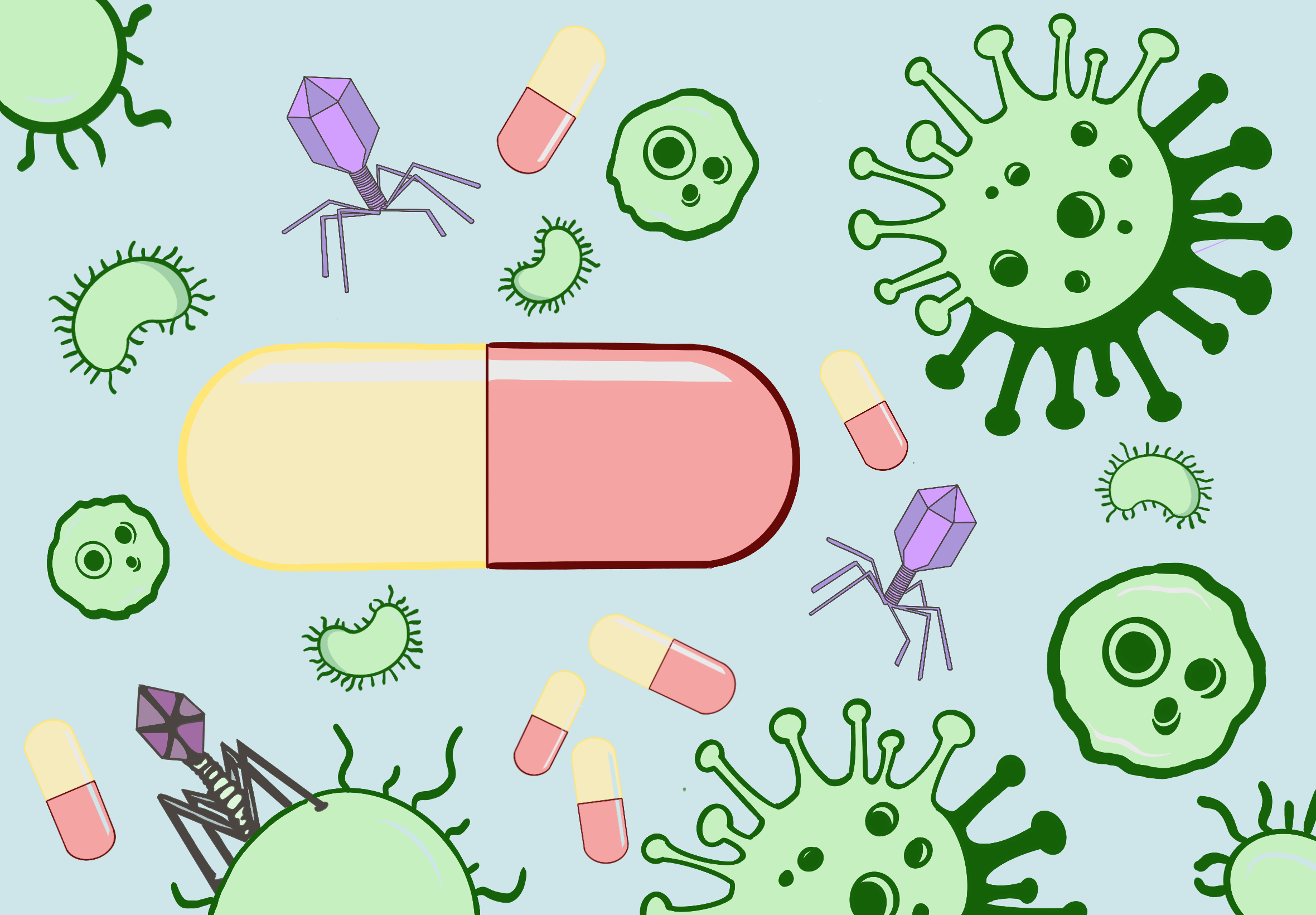
Graphic by Mariana Drove Aldana
What would the world look like without antibiotics? It is hard to imagine a reality in which their discovery never occurred. Antibiotics have become so essential that we often forget how revolutionary they once were. They help treat bacterial infections, from anything such as a skin cut to illnesses like strep throat.
However, the landscape of antibiotic effectiveness is rapidly changing, and what was once considered a reliable cure is increasingly at risk of losing its potency. As resistance grows, we must consider that these life-saving medications may no longer protect us the way they once did.
The decline of antibiotic efficiency is largely due to antimicrobial resistance (AMR), which occurs as bacterial organisms evolve after repeated exposure to treatment and cannot be eliminated. This can be explained by Darwin’s theory of “survival of the fittest,” as the more “fit” bacteria are able to survive and reproduce, creating a progeny of bacteria that is highly resistant.
To combat this growing problem, researchers are working on finding solutions, with one of these potential solutions being phage therapy. This involves the administration of bacteriophages (phages), which are viruses that infect and kill bacteria. Unlike antibiotics, phages directly target bacterial cells to kill them without affecting human cells, while antibiotics can negatively impact the microbiome of healthy cells and cause side effects. Additionally, phages are also able to mutate and evolve, unlike antibiotics, giving them an added layer of protection against bacterial resistance.
In 2025, the World Health Organization highlighted the promising potential of phage therapy as a way to treat bacterial infections. By bypassing the growing problem of AMR, they offer personalized treatment to individuals, changing the existing landscape of medical treatment.
If successful, phages could reshape medical care and redefine how bacterial diseases are treated.
As of 2021, a report published by the National Institute of Health (NIH) elaborates on case studies examining the effects of treating patients with “personalized phage cocktails,” which consist of multiple phages to target and kill various strains of bacteria. The cases report that phage therapy has worked in real patients with bacterial infections that could not be treated with antibiotics due to resistance. The success of these cases warrants further research and insight into how phage therapy can be implemented on a large scale.
At this stage, most phage therapy development is not yet in clinical trials, although some are said to have progressed beyond phase two out of four total phases. While research and testing continue, there are other countries, primarily in Eastern Europe, that have approved and implemented the use of phage therapy, indicating their viability as a treatment to get around the growing issues of AMR.
Current challenges preventing phage therapy application include obtaining regulatory approval for the treatment. Due to the personalized nature of the therapy, it is harder to develop, resulting in higher development and production costs. Making personalized treatments widely available would require a large inventory of infections that phages can treat and having them readily available for use.
In addition, manufacturing and distribution can be a challenge due to the target-specificity that phage therapy requires, entailing precision and rapid administration. Despite the innovative solutions that phage therapy offers, it would require a lot more research, clinical trials, regulations, and time to make it a widely available and accessible option.
Phage therapy reflects a growing trend in healthcare approaches: personalized medicine. Personalized medicine refers to using the genetic and biological profile of an individual to dictate how disease is prevented and treated. Personalized medicine is revolutionizing the treatment model that deems that there is one way to treat disease. This increases a patient’s chances of successfully preventing and treating illnesses as well as avoiding potentially ineffective treatments. Specifically, phage therapy involves identifying the bacterial strains that the patient is infected with and selecting the appropriate bacteriophage to attack them. By matching treatment to the infection, phage therapy reflects personalized care.
Given the benefits that phage therapy provides, it is a field with significant potential. Especially amidst the growing issue of antibiotic resistance, investing in this field can provide innovative and necessary solutions. This therapy highlights how the medical world is ever-changing and how the landscape of medicine can encounter unprecedented obstacles, reflecting the continuous need to adapt. If antibiotics become powerless against bacterial infections, phage therapy may become the solution we need.
These articles are not intended to serve as medical advice. If you have specific medical concerns, please reach out to your provider.