
Origins of the Viral World
Where did viruses come from and what caused these nature's rulebreakers to evolve?
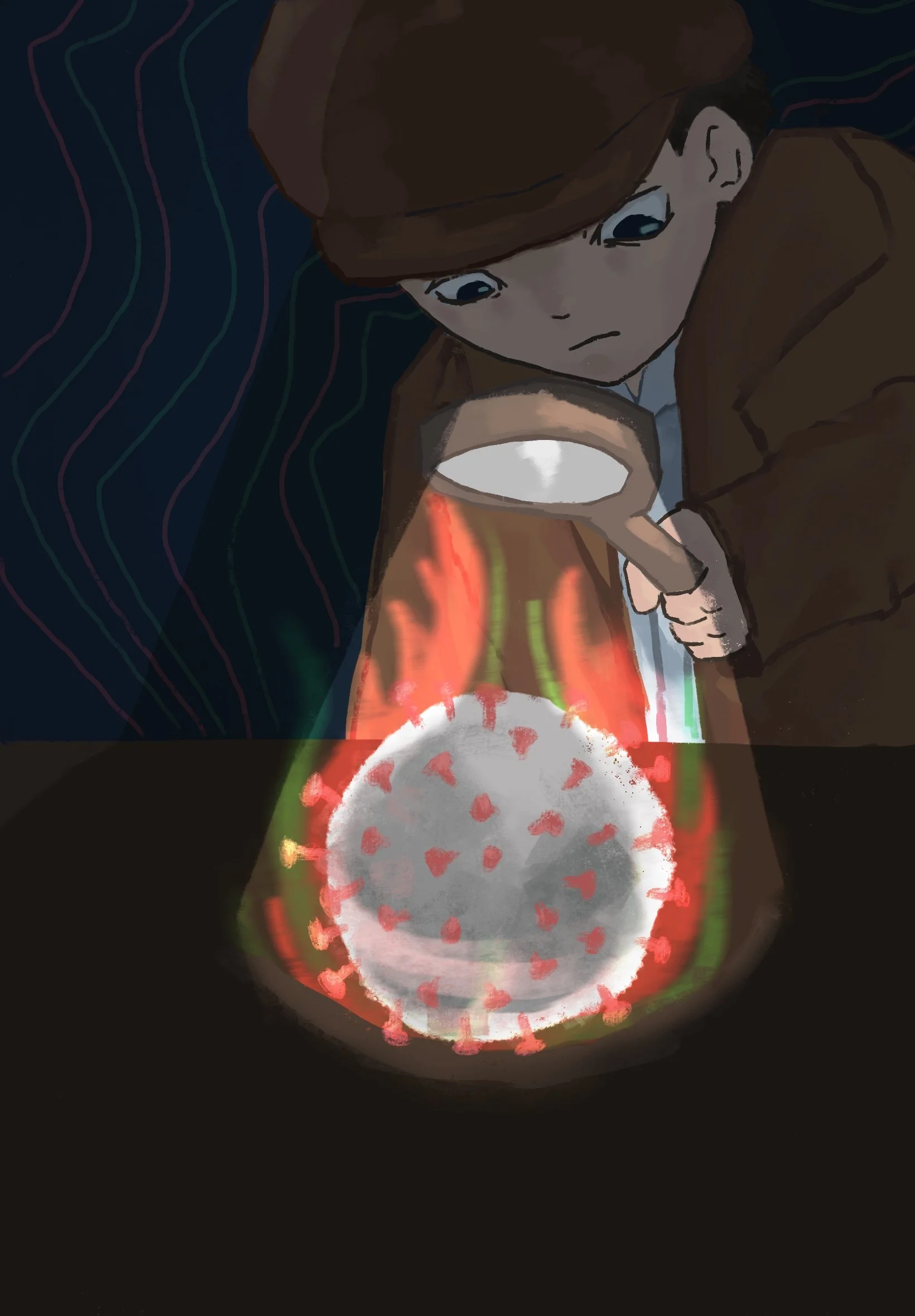
Graphic by Ziona Somy
Reading news reports about Nipah virus and avian influenza outbreaks in India on a Sunday afternoon was, in hindsight, not the most relaxing way to spend a weekend. Before I knew it, I had fallen into a rabbit hole filled with questions about viruses and their origins. How did these viruses, which wage such an arms race with humans, come about?
Perhaps there is no other biological entity as enigmatic as viruses. They differ radically from other living cells in that they contain just genetic material covered by a protein coat. This means they do not have the cellular machinery necessary for independent metabolism or reproduction. Because of this, viruses can only undergo these processes inside a living cell as a host and thus, they have colonized the no man’s land between what can be considered ‘living’ and ‘non-living’. They leave scientists, doctors and science enthusiasts like us with a lot of unanswered questions. One of those unresolved mysteries is their origin. Where did they come from and how did they evolve to become the rulebreakers that they are?
Scientists have proposed three major hypotheses in their attempt to explain this mystery. Susan L. Payne Ph.D., author of ‘Viruses: From Understanding to Investigation’ (2017), outlines these three in her book: the Virus-first hypothesis, the ‘escaped’ hypothesis, and retrograde evolution. This is also backed by David R. Wessner, Ph.D. in his Nature article titled ‘The Origins of Viruses’.
According to the ‘Virus-first’ hypothesis, viruses could have originated and evolved along with the self-replicating entities that eventually became cells. It hypothesizes that viruses could have existed earlier than our earliest cells. Wessner explains that, according to this hypothesis, since RNA was the very first replicating molecule (and not DNA), a few simple replicating RNA molecules could have evolved the ability to infect the first living cells. In that case, the modern-day single-stranded RNA viruses, the ones that just have a single strand of RNA as their genetic material, could have their evolutionary roots in these ancient, infectious RNA molecules. This could in turn mean that our history with the single-stranded RNA virus SARS-CoV-2, which caused the COVID-19 pandemic, might stretch back millions of years.
The escaped hypothesis, also called ‘progressive hypothesis’, suggests that viruses evolved after the first cells in a progressive fashion. Living cells contain mobile genetic elements called ‘retrotransposons’, which are pieces of DNA that could move within a cell’s genome or between cells. Perhaps some of these elements acquired a protein coat over time and gained the ability to infect other cells. The remarkable similarities observed between genetic structures of retroviruses and these retrotransposons provide strong support for this hypothesis. Payne also mentions in her book that this hypothesis ‘could explain the origins of retroviruses’, the family of viruses to which HIV belongs.
Finally the hypothesis of ‘retrograde evolution’ proposes that viruses evolved from free-living organisms which gradually lost key genes as they adapted to a parasitic way of survival. This reductive process could have made them depend on host cells for metabolism and reproduction, like a parasite. Major support for this hypothesis comes from large and complex viruses such as nucleocytoplasmic large DNA viruses (NCLDVs), which includes and smallpox virus. These viruses have large genomes and live partially independent from their host cells, thus causing scientists to believe they may have evolved through this reductive process.
Now, which of these hypotheses are more accurate? There is no clear answer to that question yet. Payne postulates that ‘each theory may apply to a different viral lineage’ and if so, all of these hypotheses could be accurate in their own way. However, Edward Holmes, a Professor of Virology at University of Sydney, sheds light on the growing evidence for virus-first theory in his article on viral evolution. He noted the increasing number of studies that identified clear structural similarities in the protein coat, also called ‘capsid’, among diverse viruses which did not have any obvious genetic similarities. This meant that these viruses could have had a common ancestor of an ancient origin and he called for a ‘wider sampling of viruses in nature’ as it can provide more answers to the mystery of viral origins. Understanding their origins might potentially help us in our journey to combat viral pandemics and fuel vaccine research.
So, what began as a scroll through virus outbreak reports quickly took me on a journey back in time, before the first living cells came about. As I sadly pondered where the rest of my Sunday evening went, I also realized that viruses refuse to sit neatly into any category that we come up with. They continue to be enigmatic reminders that, in spite of centuries of scientific progress, the natural world still holds secrets that we are yet to completely unravel.
These articles are not intended to serve as medical advice. If you have specific medical concerns, please reach out to your provider.