
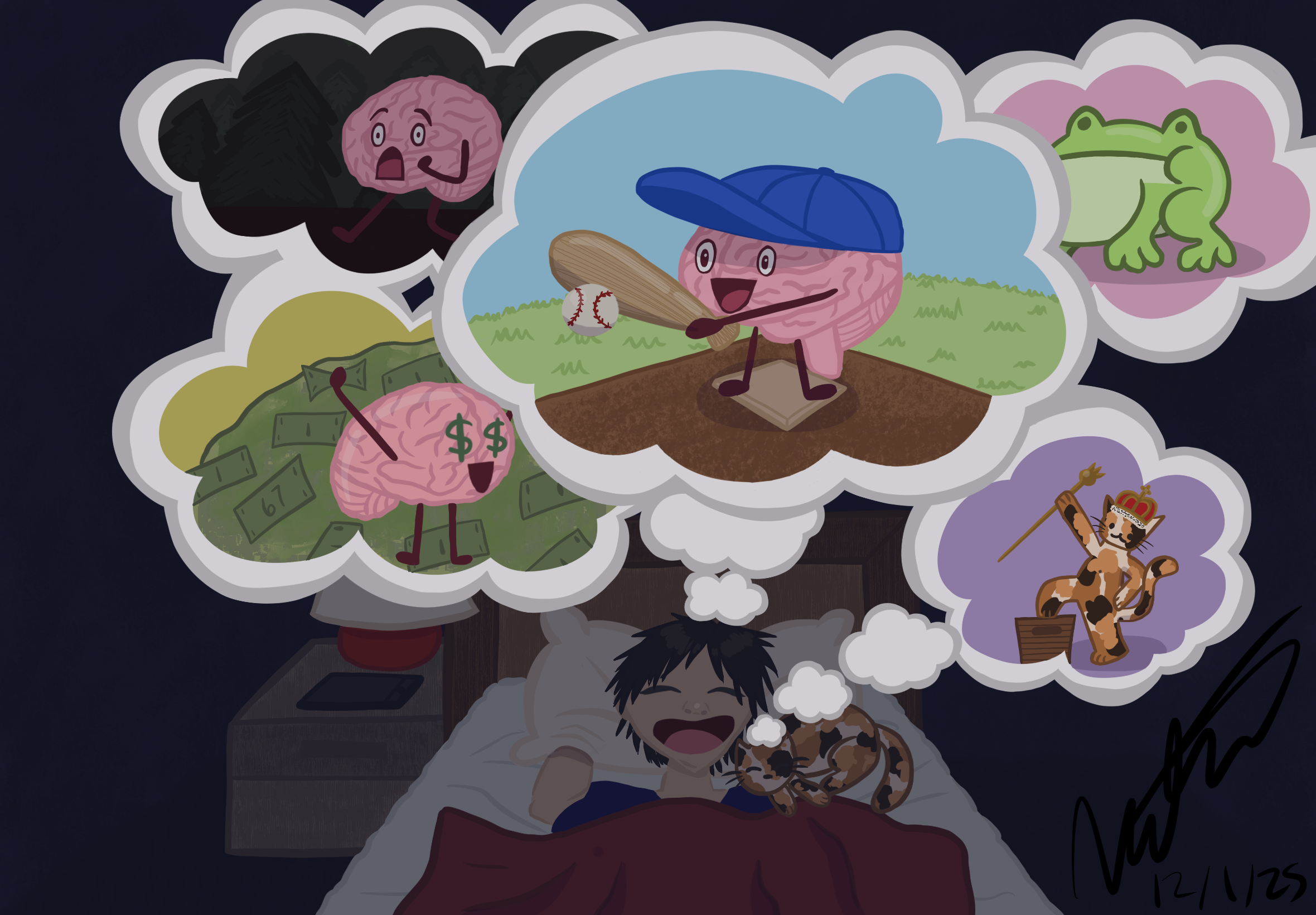
Behind the Dreamscape
What exactly is the formula for dreaming? And why do we need them in the first place?
Written by: Ziona Somy | Edited by: Cait Nickson | Graphic by: Nalani Wooton
Have you ever gotten so engrossed in a film that, when you went to sleep, the plot simply continued in your dreams? This is just one of many subconscious storylines that your brain formulated during sleep, and this sensation of dreaming is an event remarkably experienced among the entire human population. Dreams are still a subject of interest to scientists, who both acknowledge them as important markers of sleep yet have found it difficult to analyze due to their subjective character. However, through deliberate research and numerous human and, shockingly, even animal, subjects, several resolute facts can be stated about the phenomenon, all beginning with the sleep process itself.
To understand the dreamscape, one must first understand the foundation that it lies upon, being sleep. According to the Sleep Foundation, there are four sleep stages that comprise a sleep cycle experienced by humans: N1, N2, N3 or slow-wave sleep, and rapid eye movement (REM) sleep.
The first three stages are considered non-REM sleep, and each stage is both longer and harder to wake from compared to the last, creating a cycle between 90 and 120 minutes in length. N1 and N2 are the beginning stages in which the body “enters a more subdued state where body temperature drops, muscles relax, and heart rate and breathing slow” alongside an absence in eye movement and an intentional reduction of brain activity meant to transition the body into a less wakeable state. Following is N3, which is also known as “deep sleep” because of the further decrease in pulse and breathing, directed by brain activity emulating delta waves. Most studies have identified this stage as crucial for “restorative sleep, allowing for bodily recovery and growth,” necessitated by the immune system, and assistive for “insightful thinking, creativity, and memory.”
Notably, most immersive and memorable dreams come from the REM stage of sleep, which lasts anywhere from 10 to 60 minutes, though it has been observed that this is reliant on how late it is into the night since the first half of a sleep duration involves more time spent in N3 while in the second, NREM takes its place as more prevalent in the cycle. Within this stage, the body experiences temporary muscle paralysis, except for eye movement and breathing.
Furthermore, brain activity suddenly increases significantly, supporting the creative development and animated execution of dreams. According to behavioral ecologist Daniela Rößler of the Smithsonian Magazine, this is reminiscent of waking and has been recorded in a vast array of animals from marsupials such as echidnas to cuttlefish. During relevant studies, these animals performed rapid-eye-movement and slight twitches or color changes, specifically in cuttlefish, that were confirmed by brain scans to exemplify REM.
It is theorized that the purpose of dreams lies anywhere between consolidating daily experiences, processing feelings, cataloging information, and even being a simple byproduct of overactivation. Therefore, the manifestation of these functions can result in varying times of dreams, sometimes even resulting in nightmares.
According to Harvard Medical School, nightmares generally occur in the second part of the night, when REM sleep has become longer than N3, essentially around the time one is preparing to wake up. Due to this, nightmares are more often remembered and can cause greater negative effects to the person experiencing them. NHS’ Royal Papworth, indicates that nightmares can be “related to anxiety, previous stressful situations, or a result of sleep deprivation.” They can even be caused by different sleep and psychological disorders, such as narcolepsy, or most commonly, trauma.
Post-traumatic stress disorder is a common thread among many who report repeated nightmares, and Deirdre Barrett, a professor of psychology at Cambridge Health Alliance, emphasizes that this is due to an overactive amygdala within the brain, a section that is used to “identify potential threats,” yielding nighttime behaviors resembling “daytime flashbacks and general anxiety.” Therefore, to maximize the quality of one's sleep and stave off nightmares, it is recommended that those experiencing said issues instead focus on bettering their sleep hygiene, through ways of lessening stress, relaxation techniques, and imagery reversal therapy, or confronting one’s fear in a guided space of therapy to ultimately redirect the subconscious brain from reiterating it.
These articles are not intended to serve as medical advice. If you have specific medical concerns, please reach out to your provider.